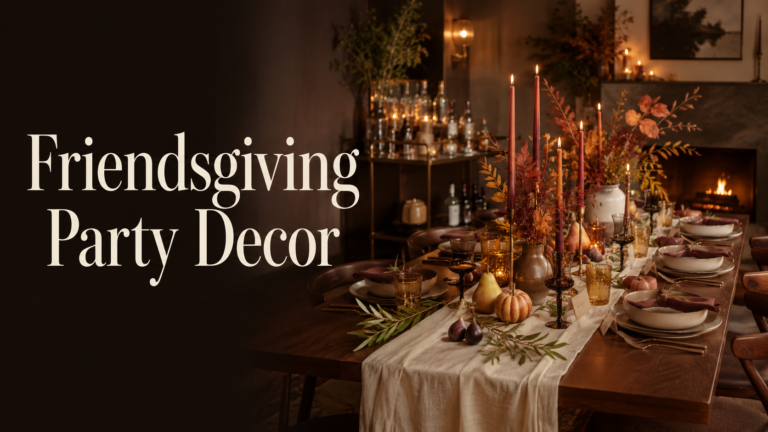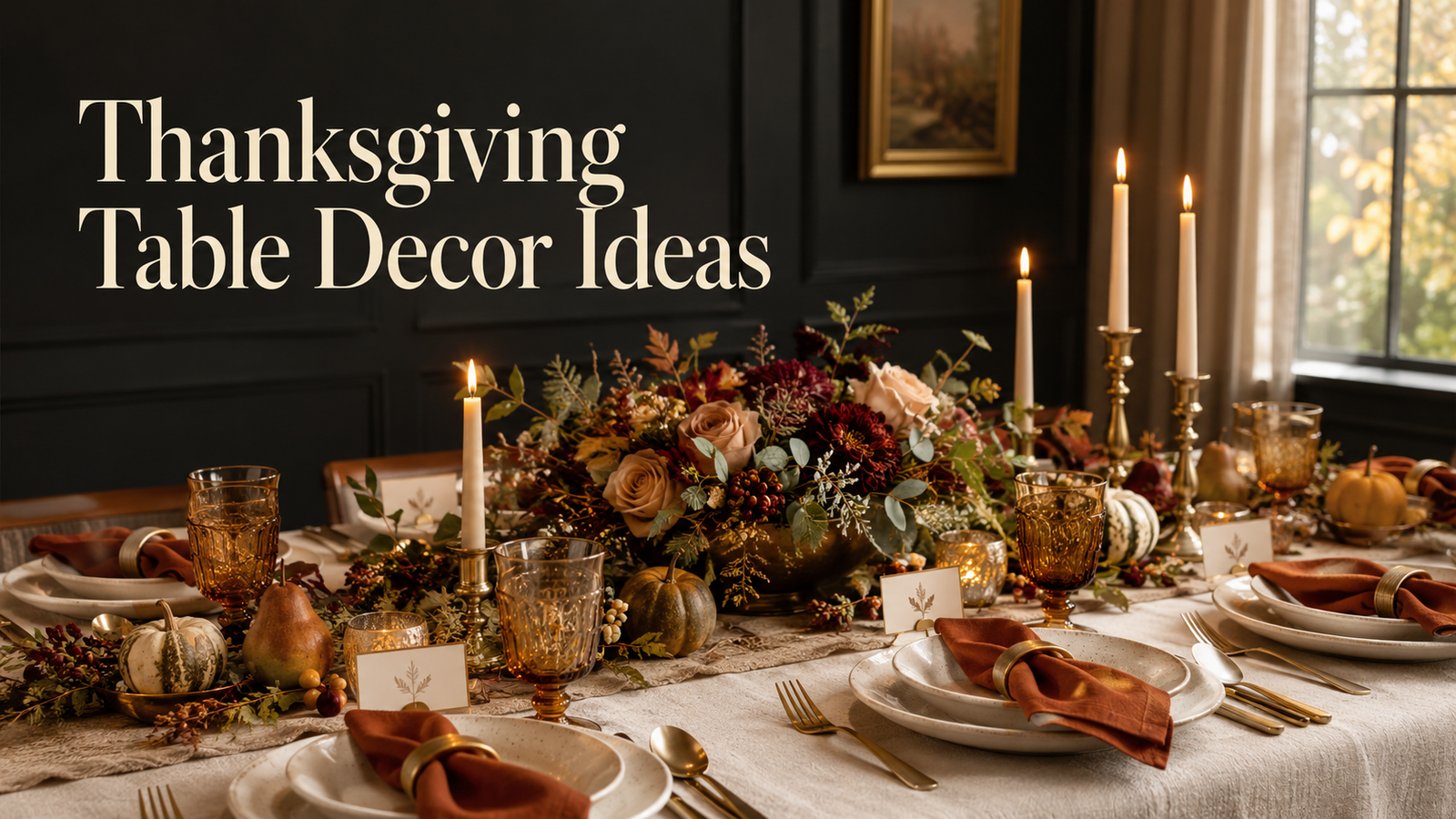
Thanksgiving Table Decor Ideas
Thanksgiving · Table Decor Guide
Thanksgiving Table Decor Ideas
How to layer rather than fill, a floral-forward direction, and four quick swaps that shift a table’s mood without redoing everything.
The Thanksgiving table decor mistake that most frequently produces a disappointing result is not under-decorating — it is over-filling. A table where every inch is occupied by a seasonal prop or decoration reads as cluttered rather than abundant, because the eye has no surface to rest on between the objects it is being asked to notice. The layered table — the one that reads as designed rather than packed — is almost always the one that has more negative space than the host initially felt comfortable leaving.
Three principles separate a layered Thanksgiving table from a cluttered one. The sections below cover each, then offer a floral direction and four quick swaps that change a table’s mood with minimal effort.
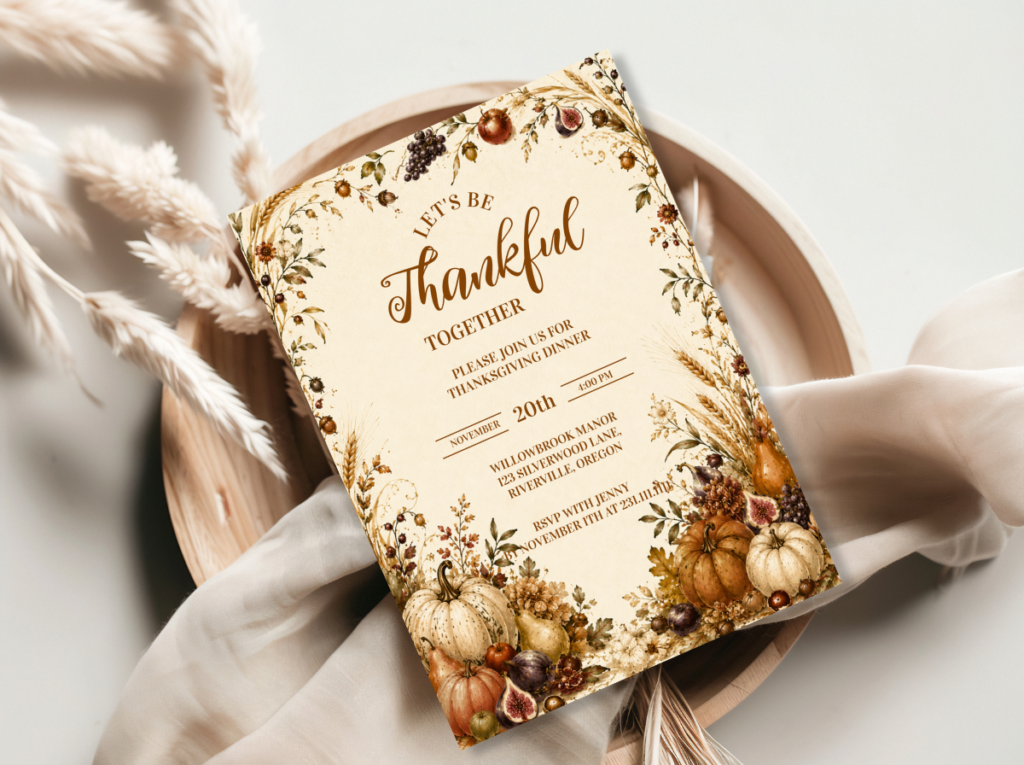
Browse the Rustic Harvest Thanksgiving collection at Lush Party Boutique — warm harvest place cards, welcome signs, and table prints for the most classic Thanksgiving table.
“The table is the whole party — everything else is just the room around it. Get the table right and nothing else needs to be perfect.”
Section 01 Layering the Table, Not Just Filling It
A layered table is built in a specific order, with each element having enough visual space to be read before the next is placed on top of it. Three principles produce this quality:
Build from the base up. The table’s foundation layers — the tablecloth or bare surface, the runner or placemats, the charger or base plate — should be placed and assessed before anything else is added. A runner that is slightly off-centre, a tablecloth with a visible fold, or placemats that are unevenly spaced will be amplified rather than hidden by everything placed on top of them. The foundation layer is the layer that most determines whether the finished table reads as intentional or assembled. Once the foundation is in place and looks right, the plates and glassware are added at each setting. The centrepiece comes last — once the base layers already look finished on their own, the centrepiece completes the table rather than compensating for an unfinished foundation.
Vary height deliberately. A table where every element sits at the same height — a flat runner, low gourds, short votives, flat place cards — reads as dimensionless regardless of how many different objects are present. Three distinct height levels produce rhythm and depth: low (the runner and the base florals or foliage), mid (the candle votives or small gourd clusters at eight to twelve centimetres), and tall (the taper candles or the candlestick holders at thirty to forty centimetres). The tall elements should be at intervals rather than grouped together — a pair of taper candles at each end of the table and one at the centre creates the rhythm that makes a long table read as a considered whole rather than a series of separate place settings.
Leave negative space. A fully packed table with no bare tablecloth or runner surface visible between the decorative elements reads as busy rather than abundant. The eye needs a surface to rest on in order to appreciate the objects it is being shown. A gap of fifteen to twenty centimetres of bare runner between each decorative cluster — a gourd and candle grouping, a small foliage bundle, another gourd and candle grouping — provides the negative space that makes each cluster read as a designed element rather than as part of an undifferentiated mass. The negative space is not emptiness; it is the visual breathing room that allows the occupied space to be fully appreciated.
🍃 Table Tip
Step back from the table before adding the centrepiece — if the base layers (runner, plates, glassware) don’t look finished on their own, more decor won’t fix it. The centrepiece completes a table that already reads as intentional; it cannot rescue a table whose foundation is unfinished or off-centre. Add it last, once everything beneath it already looks right.
The Rustic Harvest Thanksgiving collection at Lush Party Boutique — place cards and table prints in warm harvest tones.
Section 02 A Floral-Forward Table Direction
The Elegant Floral direction treats flowers as the primary design language of the table rather than as one element among several. In this direction, the centrepiece is a low floral arrangement rather than a foliage-and-gourd cluster, and the florals extend from the central arrangement to the individual place settings through a small repeated element.
The centrepiece arrangement: Low, dense, and elongated rather than tall and centred. The benchmark is the wine glass height: the arrangement’s highest point should not exceed the height of the tallest wine glass on the table, so that guests sitting across from each other have an unobstructed sight line throughout the meal. Within that height constraint, the arrangement should be as full and as generously proportioned as possible — warm-toned autumnal flowers in a deep, wide vessel rather than a few stems in a narrow one. Taper candles in holders that rise above the arrangement add the vertical element without blocking sight lines, because the candle’s slim profile is visually transparent in a way that a dense floral mass is not.
Connecting the centrepiece to the place settings: A single repeated floral element — a small stem or sprig placed on the folded napkin, or a few petals scattered near the base of each place card — ties the centrepiece to the individual settings without requiring a separate small arrangement at every seat. The single stem should be from the same flower or foliage family as the centrepiece, so that it reads as an extension of the centrepiece’s visual language rather than as a separate decorative decision. A rosemary sprig, a small eucalyptus stem, or a single bloom in the centrepiece’s primary colour: any of these placed consistently at every setting creates the connection that makes the table read as a unified designed object rather than as a centrepiece and twelve separate place settings that happen to be on the same table.
The place card as a floral-direction element: In the Elegant Floral direction, the place card is part of the design rather than a functional addition. A card in a warm harvest typeface, placed in a small gourd or a dried seedpod holder at each setting, ties the stationery direction to the natural material language of the florals. A printed place card in a font and palette that match the event’s invitation suite communicates that the table was designed as a whole — and at Lush Party Boutique’s Elegant Floral Thanksgiving Dinner collection, the stationery is designed to work as part of this table direction from the first printed piece the guest receives to the last object they pick up at their seat.
🍃 Table Tip
Repeat one floral element — a single stem or sprig — at each place setting to tie the centrepiece to the individual settings without needing multiple separate arrangements. Consistency is more effective than variety here: the same stem at every setting reads as designed; different stems at each setting reads as improvised.
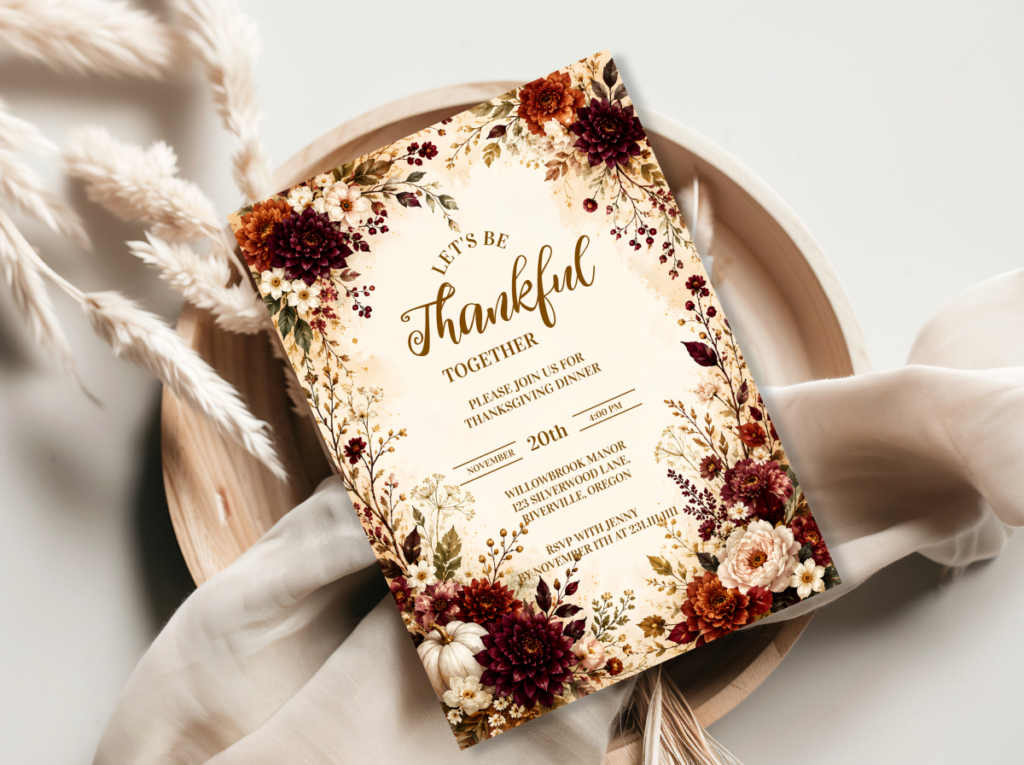
The Elegant Floral Thanksgiving Dinner collection at Lush Party Boutique — warm autumnal floral stationery designed to work as part of a floral-forward table direction.
Section 03 Quick Table Decor Swaps That Change the Whole Look
Four low-effort changes that shift a table’s mood significantly without requiring a full redecoration:
Swap the runner
A table runner is the single element that most changes a table’s aesthetic register at the lowest cost and effort. A burlap or raw linen runner reads as rustic harvest; a crisp cream linen runner reads as elegant and restrained; a dark velvet or linen runner reads as moody and dramatic. The swap takes under five minutes and produces a register change that several hours of additional decorating could not achieve by other means.
Change the candle height
Replace short votive candles with taper candles in holders, or replace taper candles with a cluster of pillar candles at varying heights. The change in candle height changes the table’s vertical rhythm entirely. Tall tapers read as formal and structured; a cluster of pillars at different heights reads as abundant and warm; a line of identical votives reads as modern and minimal. The candles are the easiest height element to change because they require no rearrangement of other elements on the table.
Replace the glassware
Clear standard wine glasses read as functional; amber or warm-tinted glasses read as harvest and autumnal; tall elegant crystal reads as formal occasion. Changing the glassware — even borrowing or sourcing a matching set in a different style for the one occasion — shifts the table’s formality register more immediately than any decorative element other than the tablecloth itself.
Add a place card at every setting
A printed place card in the table’s palette and typeface — from the Lush Party Boutique Rustic Harvest or Elegant Floral collection — transforms the table from a well-decorated dining surface into a hosted occasion. The place card is the element that communicates that the host considered each guest specifically; its presence reads as hosting in a way that no centrepiece or runner can replicate, because it is addressed to a person rather than to a table.
The Rustic Harvest Thanksgiving collection at Lush Party Boutique — place cards and harvest table prints that complete any Thanksgiving table direction.
Frequently Asked Questions
What order should I decorate the Thanksgiving table in?
Start with the foundation: tablecloth or bare surface, then runner or placemats, positioned and straightened before anything else is placed. Then set the individual places — charger or base plate, dinner plate, napkin, glassware — working from one end of the table to the other so the spacing stays consistent. Step back and assess the base layers before proceeding. Once the foundation looks finished and the place settings are in position, add the decorative centrepiece elements: the foliage runner or floral arrangement, the gourd or botanical clusters, the candle holders. Place the candles and any individual place setting details — place cards, small stems or sprigs, favours — last. The order matters because each layer needs to be assessed before the next obscures it.
How do I avoid an over-decorated Thanksgiving table?
The clearest test is negative space: if no bare tablecloth or runner surface is visible between the decorative elements, the table is over-decorated. Remove objects one at a time until a visible gap appears between each decorative cluster — fifteen to twenty centimetres of bare surface between groupings is the minimum for the table to read as designed rather than packed. The second test is height: if every element on the table is at approximately the same height, the table reads as flat regardless of how many objects it holds. Remove the lower items and replace them with a few taller elements — taper candles, candlestick holders — to introduce the height variation that produces visual rhythm. The principle in both cases is the same: less objects, more intentional arrangement of each.
Can I use everyday dishes for Thanksgiving table decor?
Yes — everyday dishes used intentionally read as considered rather than budget-constrained. The key is that every dish on the table should be from the same set or from sets that share a quality: the same tone (all cream, all white, all earthy), the same finish (all matte, all gloss), or the same material register (all ceramic, all stoneware). A charger plate in a warm tone beneath an everyday dinner plate unifies mismatched everyday pieces by providing a consistent visual ground at every setting. The place card is the most effective element for elevating everyday tableware: a beautifully printed place card in the table’s palette communicates that the table was hosted rather than assembled, regardless of whether the plates beneath it are everyday or occasion-only.
Layer Up · Vary Height · Leave Space · Place Card Last
Shop Thanksgiving Table Stationery
Place cards, welcome signs, and menu cards in rustic harvest and elegant floral directions — the printed layer that completes any Thanksgiving table.