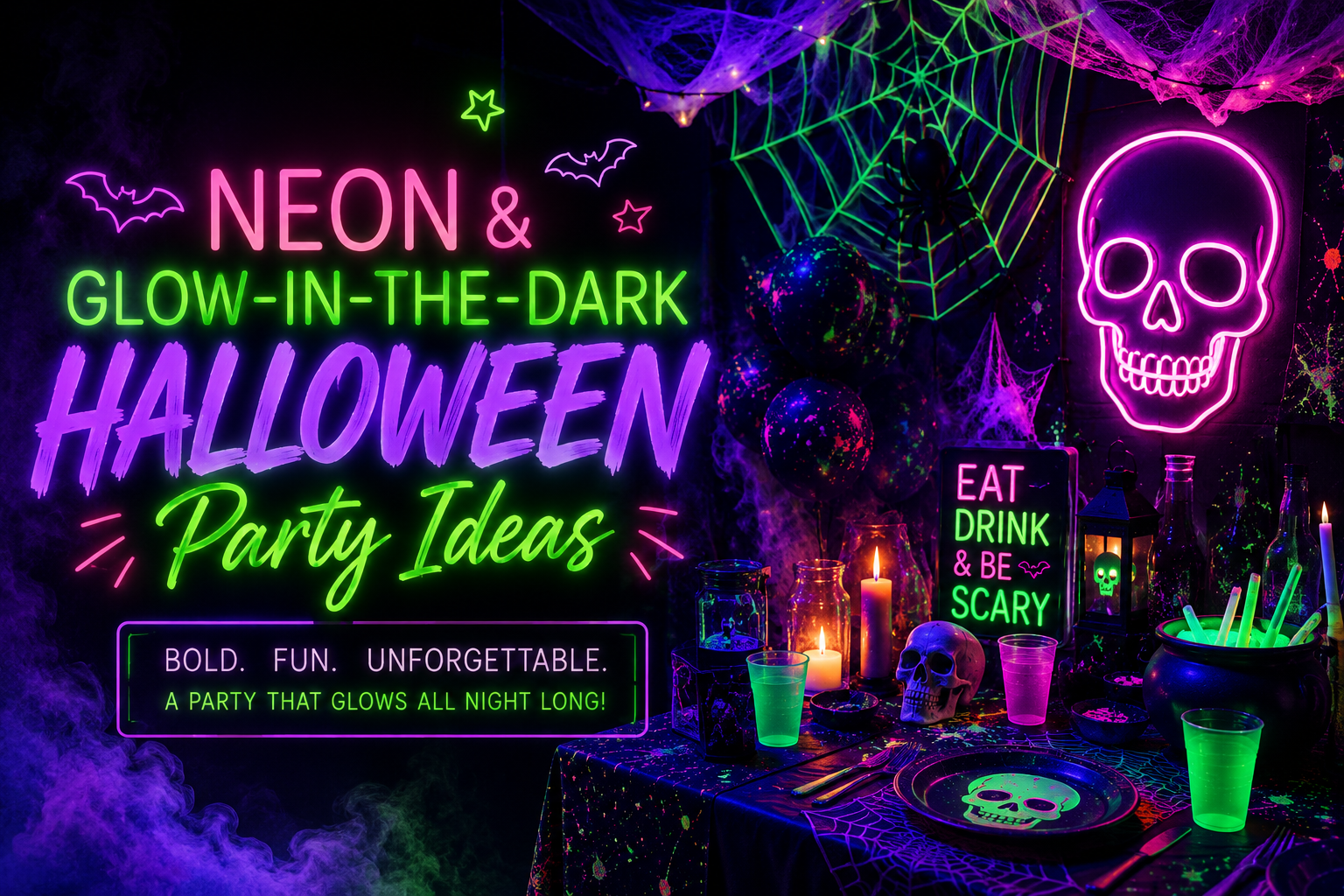
Neon & Glow-in-the-Dark Halloween Party Ideas
Halloween Party Ideas · Neon & Glow
Neon & Glow-in-the-Dark Halloween Party Ideas
The three black-light principles, the complete decor and activity guide, the setup and stationery brief, and the fluorescent colour rules that actually make things glow.
The neon Halloween party is the only Halloween direction that does not fully exist until the lights go off. Every other direction is designed to be experienced at normal room lighting; this one is designed for the moment the overhead lights cut and the UV sources activate, and every element the host spent the day assembling suddenly reveals itself as a glowing, reacting, connected visual world that was invisible an hour before. That transformation is the entire experience, and it is produced by one decision made correctly before any decoration is purchased: the canvas must be black.
⚠ This post contains affiliate links. As an Amazon Associate, I earn from qualifying purchases at no extra cost to you. I only recommend products I genuinely believe will add value for my readers. Thank you for supporting Lush Party Boutique.
Shop the Neon & Glow-in-the-Dark Halloween collection.
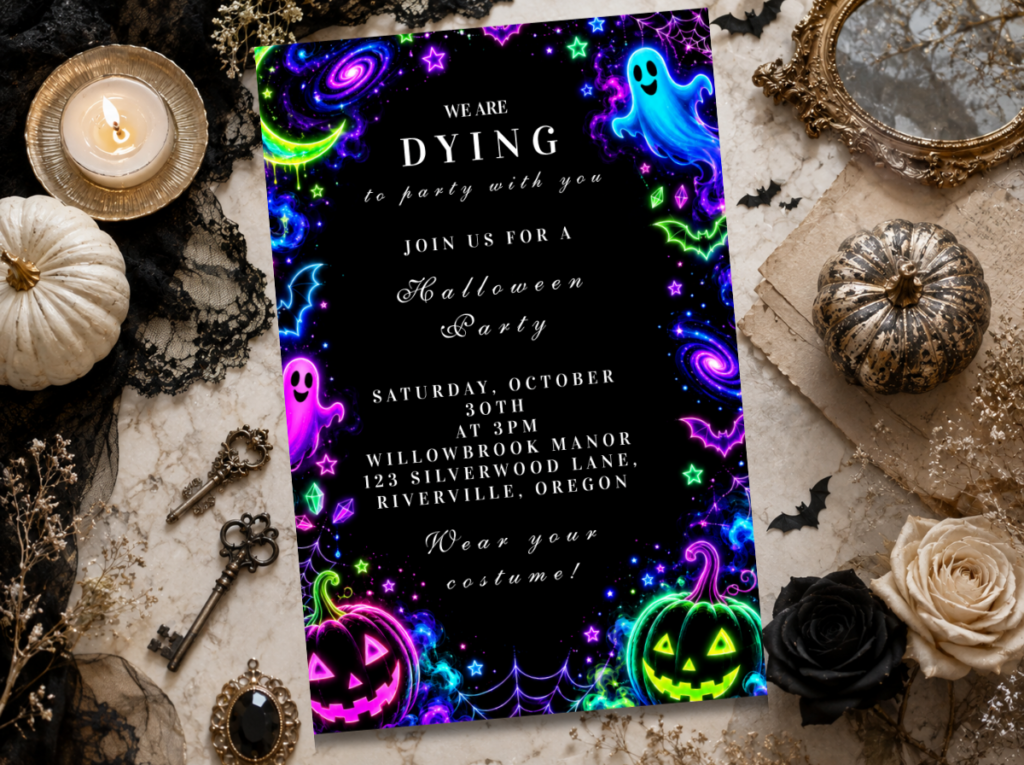
Invitations and stationery designed for the dark-background, neon-outline aesthetic.
“The party that only really turns on once the lights go off. Everything the host spent the day setting up is invisible until that moment — and then it is entirely visible at once.”
Section 01 What Makes a Neon Halloween Party Work — Three Principles
The neon Halloween direction is the only one where the lighting is the decoration, not a backdrop for it. Three principles govern every decision — from the colour of the linen to the number of neon tones in the balloon cluster.
Principle 1
Black Is the Canvas, Not a Colour Choice
What fails: Leaving wall colours, linen, and decoration surfaces in their standard colours (white walls, cream tablecloths, coloured balloons) and then adding neon elements to them. Neon elements on a white or light-coloured surface have approximately one-quarter of the visual impact they have on a black surface, because neon glow reads as bright relative to the darkness surrounding it — not relative to the neon colour itself. A neon green element on a white tablecloth reads as a bright green element. The same element on a black tablecloth reads as glowing.
What works: Every surface the host controls defaults to black or near-black before any neon element is added. Black balloons as the primary balloon volume; black tablecloths and table coverings; black or very dark surfaces for the entrance and backdrop zones. Where surfaces cannot be changed (white walls in a rented venue, light-coloured floors), these need to be covered or redirected with black paper, dark fabric, or positioned so that the UV lighting does not reach them directly. The black surface is not decoration — it is the technical requirement that makes every neon element work.
🎨 UV-reactive neon paint set: Fluorescent paint is what turns plain black tablecloths, poster board signage, and DIY decor into glowing centerpieces under blacklight. A multi-color set covers signage, cups, and accent pieces without buying separate bottles.
Principle 2
Two or Three Neon Colours Maximum — One Dominant, One Supporting
What fails: Four, five, or six competing neon colours distributed at equal weight across the decoration. Multiple neon tones at equal prominence reads as chaotic and commercial rather than as curated — because neon at full intensity is inherently high-energy, and multiple competing high-energy tones without a clear hierarchy produce visual noise rather than visual excitement.
What works: One dominant neon colour that appears on the largest surfaces and in the highest frequency (neon green as the primary colour in the balloon cluster, the tablecloth detail, the drink cups); one supporting neon colour that appears only in small accents (neon purple in a few individual balloons, in the drink garnish, in one banner element). Two effective combinations: neon green as dominant with neon purple as the supporting accent (the classic Halloween neon pairing, because green and purple are the Halloween colours closest to the neon register); or neon pink as dominant with neon blue as the supporting accent (the more pop-art Halloween neon direction).
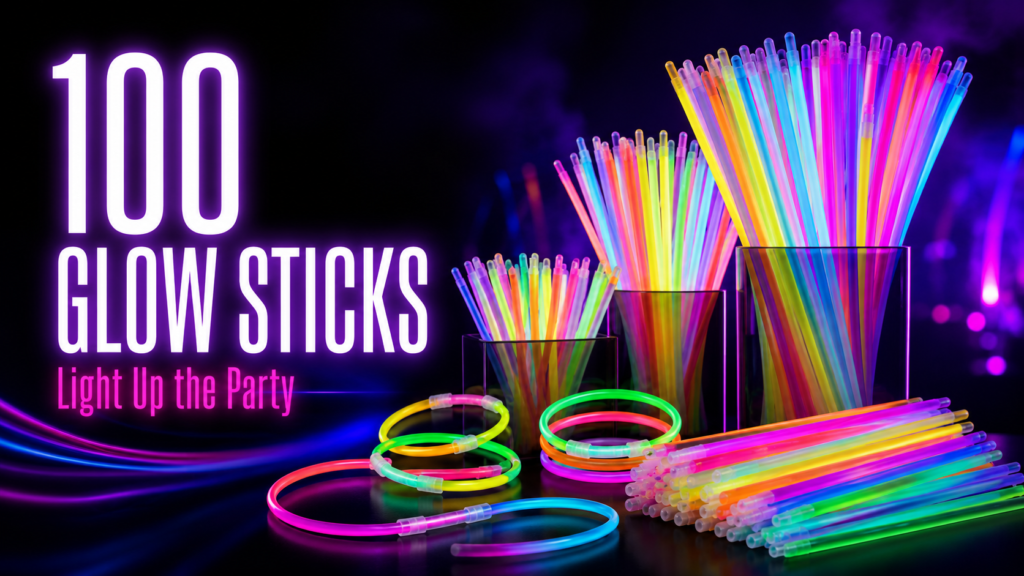
✨ Bulk glow sticks pack: A glow-stick bar is one of the easiest interactive touches at a neon party — hand them out as bracelets and necklaces, or drop them into drinks for a reactive glow. Buying in bulk keeps the per-guest cost low.
Principle 3
UV-Reactive Materials Do Double Duty — Use Them Instead of Powered Elements
What fails: Relying entirely on battery-powered glow sticks and LED elements as the neon decoration. These produce light rather than reacting to it — which means they look the same under UV and under normal light, they require battery management through the party, and they do not produce the full-surface reactive glow that UV-fluorescent materials achieve.
What works: UV-reactive fluorescent paint, tape, and fabric as the primary decoration material. White card stock and white fabric react strongly under UV without any fluorescent pigment added; neon-coloured fluorescent paint on a black surface produces a glow that powered elements cannot replicate. Neon tape applied as geometric accents to black balloons, black cups, and table surfaces gives every surface a reactive quality at near-zero cost. White table-tennis balls placed in dark cups react dramatically under UV and require no power source. Glow sticks work well as individual guest elements (one per guest) but should not be the primary decoration source.
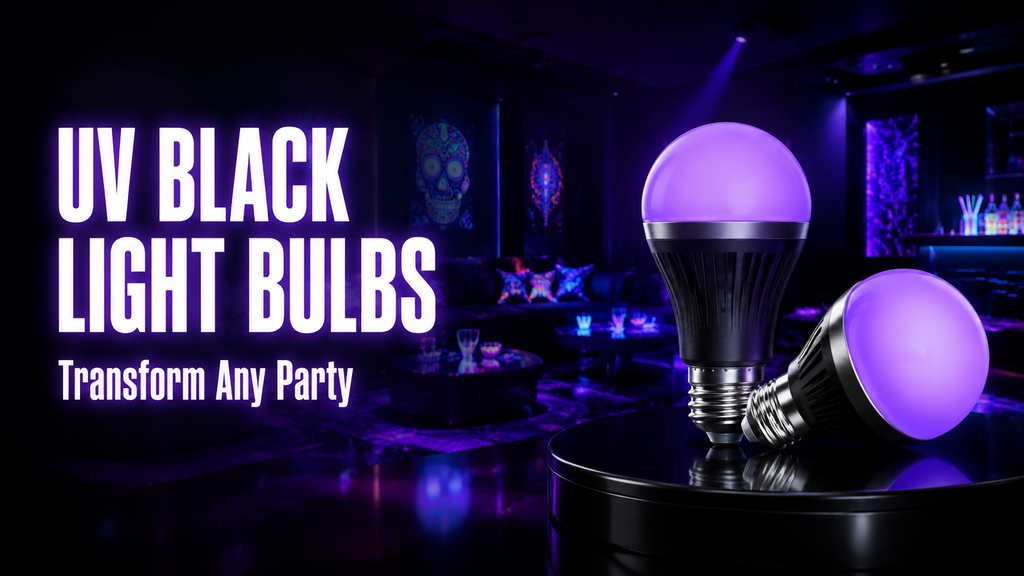
🔦 UV blacklight bulb or LED strip: The single most important buy for this theme — without a real UV light source, none of the neon paint, face paint, or tape will actually glow. A plug-in bulb or LED strip lets you light an entryway, dance floor corner, or dessert table exactly where you want the effect.
⚡ Styling Tip
Test every element under actual black light before party day, not just under normal lighting. A colour that looks neon in daylight can go flat and grey under UV — only true fluorescent pigments glow. The test: hold each element under a UV source in a darkened space. If it glows brightly, it is fluorescent. If it looks grey or dull, it is not and should be replaced with a specifically fluorescent version of that colour.
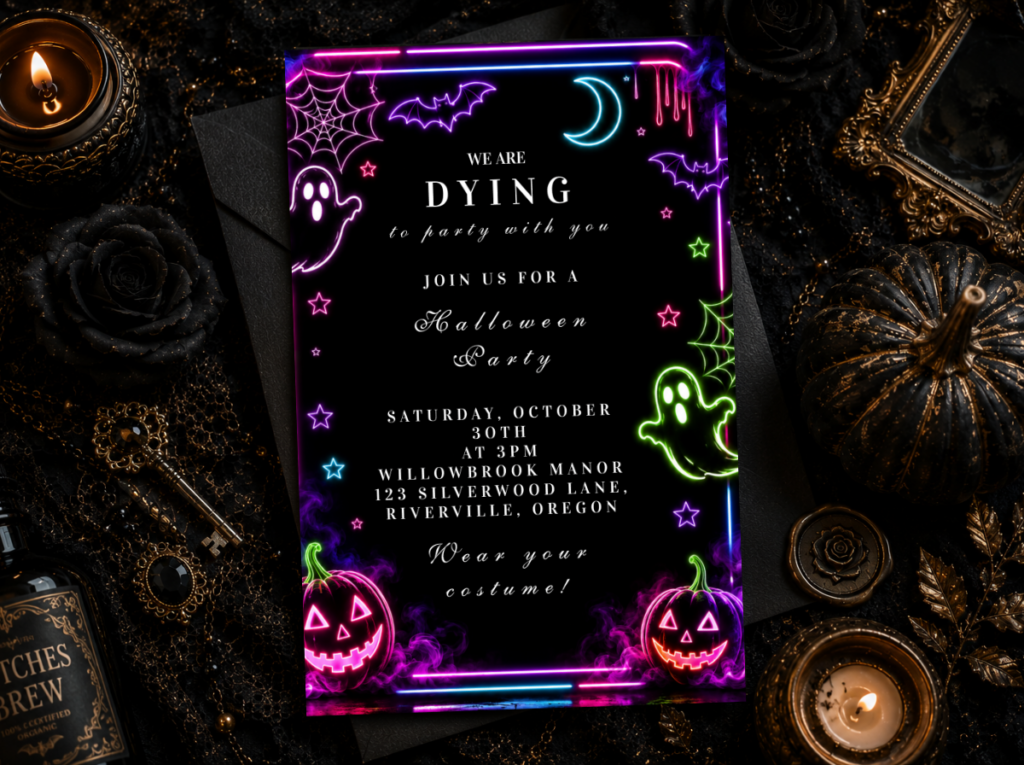
The Neon & Glow-in-the-Dark Halloween collection carries dark-background stationery designed for the UV-reactive aesthetic.
Section 02 Neon Decor, Drinks & Activities
Every element follows the three principles: black canvas, maximum two neon tones, UV-reactive materials preferred over powered ones.
Black balloon arch with neon-tape accents — the backdrop statement
A balloon arch composed primarily of matte black balloons — the largest balloons in the arch should all be black, providing the dark canvas that the neon accents will glow against. Into this black arch, add a smaller number of balloons in the dominant neon colour (neon green or neon pink) and an even smaller number in the supporting neon colour. The ratio: approximately 60% black, 30% dominant neon, 10% supporting neon. The neon-tape accent: strips of fluorescent neon tape applied as simple geometric patterns — lines, crosses, small spirals — onto individual black balloons throughout the arch. Under UV, the black balloons disappear and the tape accents appear as floating geometric shapes. This effect costs a few metres of neon tape and produces more visual drama under UV than any powered alternative.
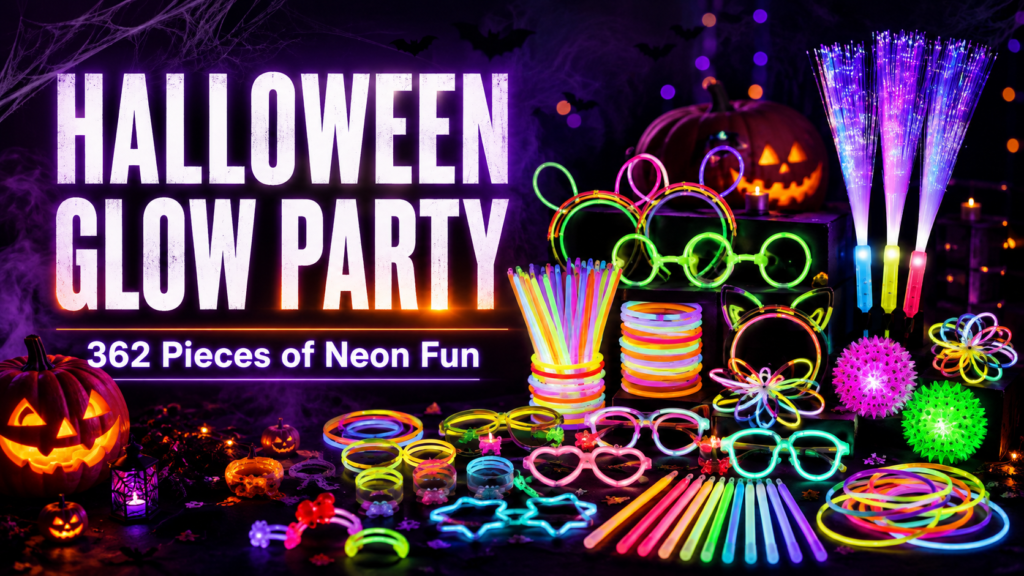
🎈 Black matte + neon balloon set: Matte black balloons create the dark canvas this theme depends on, while the neon balloons mixed in provide the color pop for arches and clusters. Buying them as a set keeps the ratio balanced without separate orders.
Glow-stick bar station — the interactive drinks moment
A dedicated drinks station with a black surface covering, white or clear cups that react under UV, and one glow stick per cup placed inside before the drink is poured. The drink itself is the colour of the dominant neon tone — a neon green sports drink base, a blue electrolyte drink, or a tonic water that naturally fluoresces under UV (tonic water containing quinine fluoresces blue-white under UV without any additive). Label the station with neon-outlined labels on black card — ‘Witch’s Brew,’ ‘Toxic Tonic,’ ‘Radioactive Punch’ — in fluorescent paint or printed on fluorescent card stock. The glowing drink in a glowing cup at a glowing station is the most photographed moment of the neon Halloween party.
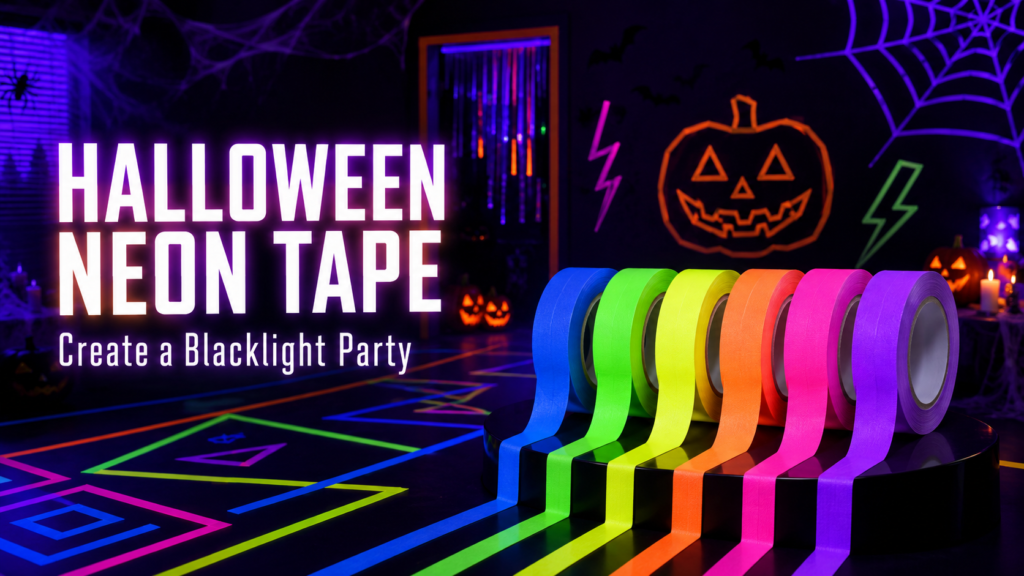
🟩 Multicolor neon tape: Neon tape is the fastest way to build the geometric wall and table patterns that define this theme — no painting required, just peel and stick. A multicolor roll set covers backdrops, table edges, and signage in one purchase.
UV-reactive tablecloth with neon paint details — the table surface
A plain black fabric tablecloth as the base, with a design painted directly onto it in fluorescent neon paint: a large bat silhouette, a web pattern from the corners, a border of handprinted dots in the dominant neon colour. Under normal light, the black tablecloth reads as simply black. Under UV, the painted design appears at full neon intensity. This technique requires one pot of fluorescent neon paint and one painting session the day before the party — the paint dries flat under normal light and activates under UV. Neon tape strips at the table edge as a finishing detail that glows under UV without any additional paint application.
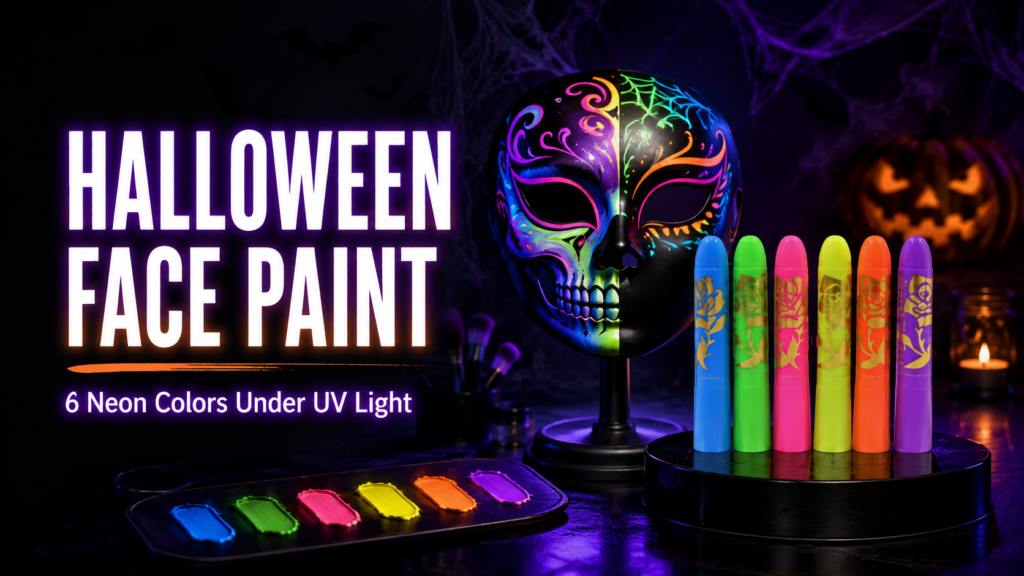
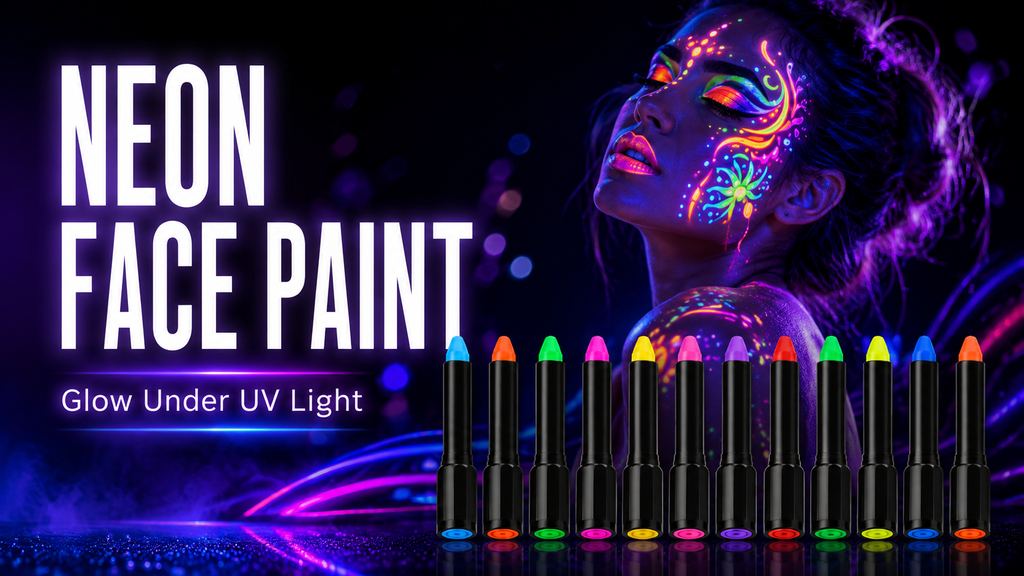
💄 UV-reactive neon face paint sticks: Face paint that only glows under blacklight is what turns guests into part of the decor once the lights go down. Stick-style paint is mess-free and easy for kids and adults to apply themselves.
Black-light dance-floor zone — the party’s centrepiece activity
One room zone or one corner of the main space designated as the UV dance floor, where the UV light sources are most concentrated and the music is directed. The floor zone: spread a black or dark fabric ground if the floor is light-coloured. Around the perimeter: UV-reactive string lights (fluorescent rather than LED-coloured, which don’t react to UV). On the walls of this zone: neon tape geometric patterns — quick to apply, dramatic under UV, removable without damage. Provide one neon face paint stick in the dominant neon colour at the entrance to the zone, so guests can add a UV-reactive face detail before entering. The combination of UV-reactive wall decoration, UV-reactive face paint, and UV-reactive clothing (many white garments fluoresce under UV) makes every guest part of the decoration as soon as they enter the zone.
⚡ Styling Tip
Pick one dominant neon colour and one supporting colour — never three at equal weight. The dominant colour should repeat across the largest surfaces: the drink cups, the table detail, the majority of the neon balloons. The second colour appears only in small accents: a few individual balloons, the drink garnish, one banner element. When both colours appear at equal weight, neither reads as dominant and the visual energy becomes chaotic rather than directed.
Browse the full Neon & Glow-in-the-Dark Halloween collection for dark-background invitations and stationery.
Section 03 Neon Invitations & Setup Tips
The invitation is the first preview of the party’s visual world — and for a neon Halloween party, it should communicate the dark-background, neon-outline aesthetic before any guest arrives. A dark (near-black or deep charcoal) invitation background with neon-coloured outline motifs — a bat, a pumpkin, a web — tells guests exactly what register to expect: dark, high-contrast, and specifically designed. It also communicates practically: guests who see a neon-themed invitation know to bring or wear white or light-coloured clothing, which will fluoresce under UV and make them part of the decoration themselves.
One practical setup note that determines whether the entire party works: UV light sources need to be positioned at the surfaces they are intended to activate, not at the centre of the room ceiling. A UV bulb at the centre of a room illuminates the ceiling and the middle of the space; it reaches the walls and the floor at diminished intensity. UV strip lights positioned along the lower sections of the wall, aimed across the tablecloth and the floor surface, produce the strongest activation of every UV-reactive material in the room. Test the UV positioning with the room in full darkness at least one hour before guests arrive, and adjust any source that is producing a cone of UV light rather than a wash across a surface.
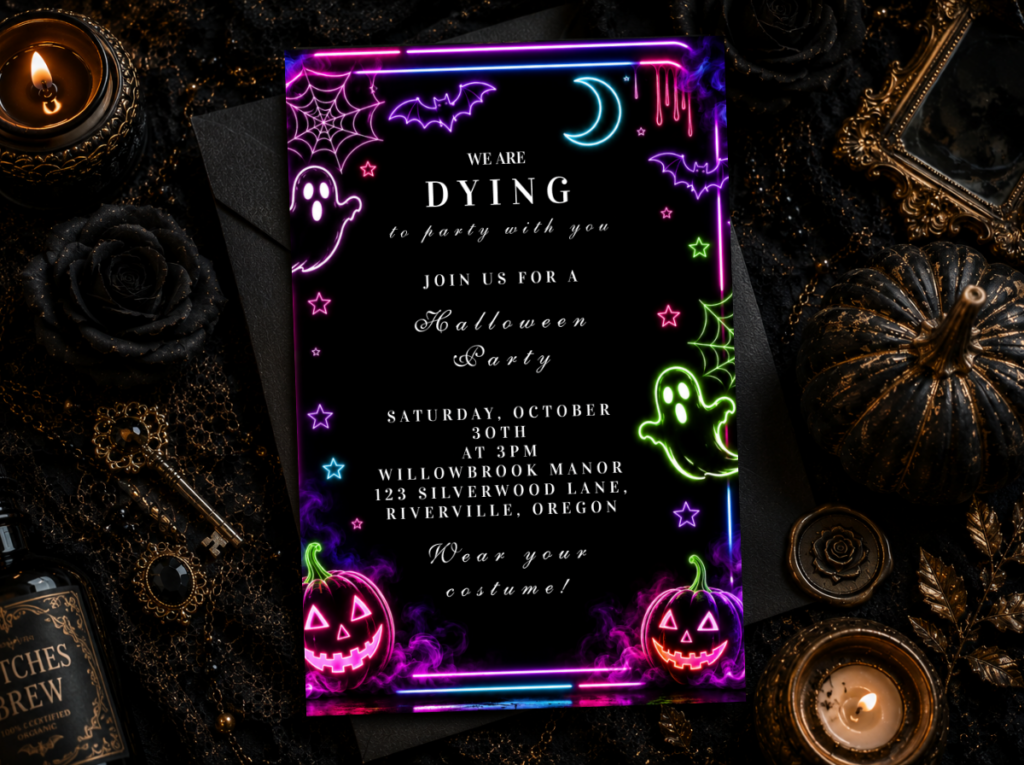
Browse both collections for neon Halloween stationery and All Halloween options.
Frequently Asked Questions
What colours actually glow under black light versus just looking bright?
Only colours containing fluorescent pigments glow under UV — and fluorescent pigments are a specific chemical category, not just a visual property. True fluorescent colours that reliably glow under UV: neon green (the most reactive; the strongest glow of any common colour), neon yellow, neon orange, neon pink, and neon blue in their specifically fluorescent formulations. White glows strongly under UV because most white materials contain optical brighteners. Tonic water containing quinine fluoresces blue-white under UV without any pigment. Colours that look bright in daylight but do not glow under UV: standard bright colours (regular green, regular blue, standard orange) without a specifically fluorescent formulation. The practical test: hold the item under a UV source in a dark space. True fluorescent items produce an immediate, strong glow; non-fluorescent items appear dull or grey.
Does the neon Halloween direction work for kids or is it better for adults?
Both, with different emphasis. For children aged eight and older, the glow-stick elements, the UV dance zone, and the face paint stick are specifically exciting in a way that produces high engagement throughout the party. The dark room with glowing elements reads as magical rather than frightening for this age group — which makes it a genuinely Halloween-appropriate direction for older children. For younger children (under six), the dark room environment with UV lighting can be visually intense; the neon direction is better suited to ages eight and older for this reason. For adults, the neon direction is the most energy-forward and most specifically dance-party appropriate of all the Halloween directions — it is the one that most naturally produces a party that keeps going rather than winding down.
How much UV equipment do I actually need for a neon Halloween party?
Less than most hosts expect, because UV-reactive materials do the work that powered elements cannot. For a standard domestic party space (a living room, a garden, a hired hall), four to six UV bulbs in standard light fittings positioned at the lower wall level rather than at the ceiling, plus one or two UV strip lights aimed across the primary table surface and the dance floor zone, produces sufficient UV coverage to activate every fluorescent element in the space. The critical variable is not the number of UV sources but their positioning — UV light needs to be aimed at the surfaces where the reactive materials are, not at the centre of the room. More UV sources do not compensate for poor positioning; correctly positioned fewer sources produce a better result than many poorly positioned ones.
Lights Off
Neon Halloween Party Stationery
Dark-background invitations and stationery with neon-outline motifs — the first preview of the party’s visual world before any guest arrives.