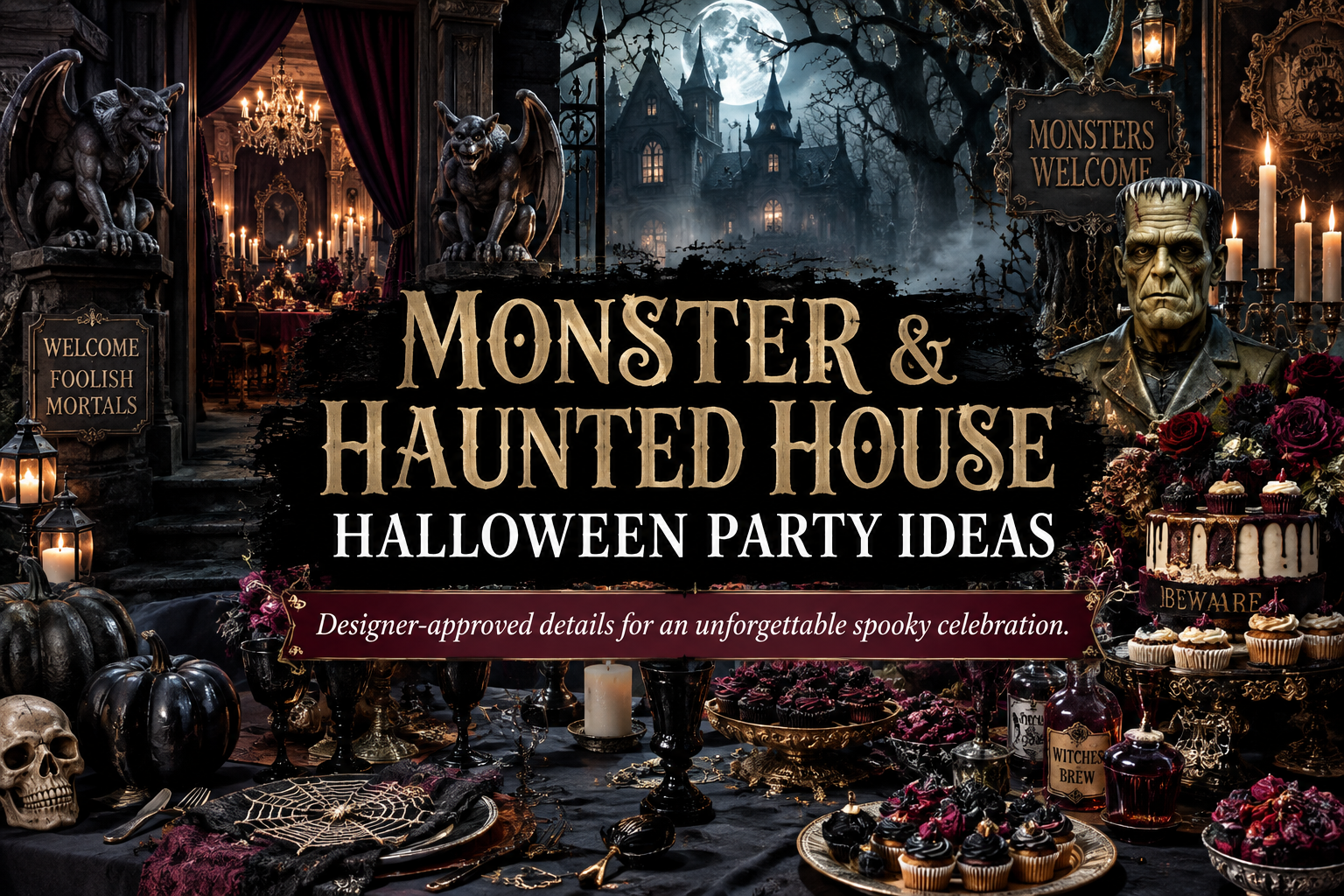
Monster & Haunted House Halloween Party Ideas
Halloween Party Ideas · Monsters & Haunted House
Monster & Haunted House Halloween Party Ideas
The character-first approach, the three creature types rule, the complete decor guide, and the stationery that sets the narrative before any guest arrives.
Something crawled out of the basement, and it brought snacks. The monster and haunted house Halloween party is the character-driven direction — the one Halloween approach where specific creatures with specific personalities show up as distinct presences in the decoration rather than as a general atmospheric quality. A stitched-together green monster with mismatched bolts, a shambling zombie in a dinner jacket with a lopsided grin, a translucent ghost drifting through a crumbling mansion doorway — each one is a character with a posture, an expression, and a specific place in the story the party is telling. The mood comes second; the cast comes first.
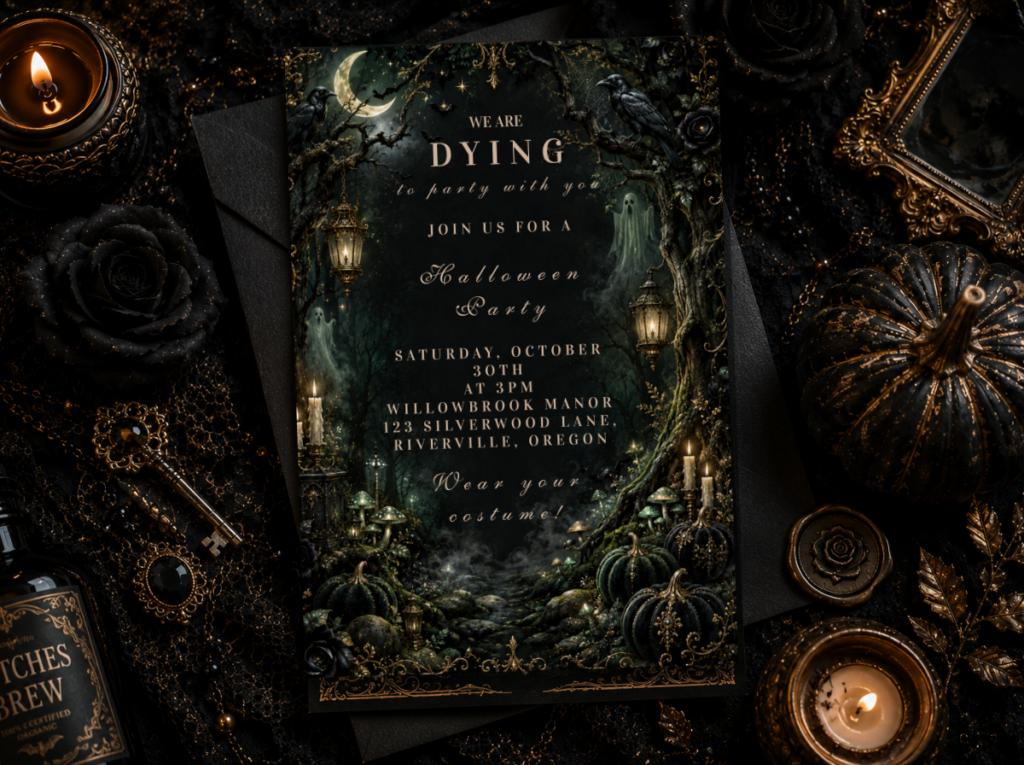
Shop the Monster, Zombie & Haunted Halloween collection.
Invitations, banners, and favour tags in the character-driven haunted house aesthetic.
“Something crawled out of the basement, and it brought snacks. The monster Halloween party is the one where the creatures have personalities — and where the whole room is a story about who turned up uninvited.”
Section 01 What Makes This Direction Distinct — Characters, Not Mood
The monster and haunted house direction is the narrative-driven alternative to the atmosphere-first spooky approach. Where spooky Halloween removes elements until the darkness does the work, this direction adds characters until the room has a cast. Three principles define the distinction and establish the register that makes this direction work.
Character 1
The Stitched Monster — Assembled, Not Born
Comic-book playful with bolts and patchwork stitching visible
Wrong register: A detailed realistic rendering of a bolt-necked monster with facial injury or graphic anatomical detail. This reads as horror-movie, which is a different register entirely and produces an uncomfortable rather than festive response in the room.
Right register: A flat-illustrated monster in classic green with oversized bolts at each temple, mismatched button eyes, and visible stitching lines drawn as simple parallel marks across the body. The posture is key: arms slightly raised, feet shuffling, expression somewhere between confused and pleased — the look of a creature that has not attended a party before and is doing its best. The detail communicates character, not threat.
Character 2
The Shambling Zombie — Undead But Polite
Classic horror-adjacent, redeemed by personality and a dinner jacket
Wrong register: A zombie rendered with graphic realistic decay detail. The zombie as a horror-realism illustration belongs to a completely different genre register — it removes the playful quality that makes the monster party direction work and replaces it with something that reads as genuinely unsettling rather than as fun-spooky.
Right register: A zombie in formal dinner wear — a dinner jacket with one lapel slightly detached, a bow tie askew, a pocket square dangling loose — rendered in the flat storybook style. The face: a lopsided grin, slightly glassy eyes, one eyebrow raised as if the evening’s events have been mildly surprising. The zombie’s character is ‘person who arrived at the wrong party sixty years late and is gamely trying to enjoy it.’ Personality, not menace.
Character 3
The Crumbling-Mansion Ghost — Aristocratic and Slightly Offended
Grand but faded, haunting the corridors of better days
Wrong register: A ghost rendered as a formless white shape or as a horror-adjacent transparent figure with a distressed expression. This removes the character dimension that distinguishes the haunted house direction from generic Halloween and produces an element that reads as atmosphere rather than as cast member.
Right register: A ghost in period formal dress — a floor-length gown for a feminine ghost, a top hat and frock coat for a masculine one — rendered semi-transparent in a silvery lavender tone, carrying a candelabra, looking down the length of a long corridor with an expression of mild affront at the party being held in its house. The ghost is the host who did not invite anyone and is coping with the intrusion through impeccable manners and one magnificently raised eyebrow.
🧟 Styling Tip
Give your monsters personality through posture and expression, not through gore detail. A zombie with a lopsided grin and a detached dinner jacket lapel reads as fun-spooky; a zombie with graphic realistic decay reads as horror-movie, which is the wrong register for a party. The illustration standard for this direction: if the character would look comfortable on a children’s book cover from the 1960s, it belongs. If it would not, it belongs to a different direction.
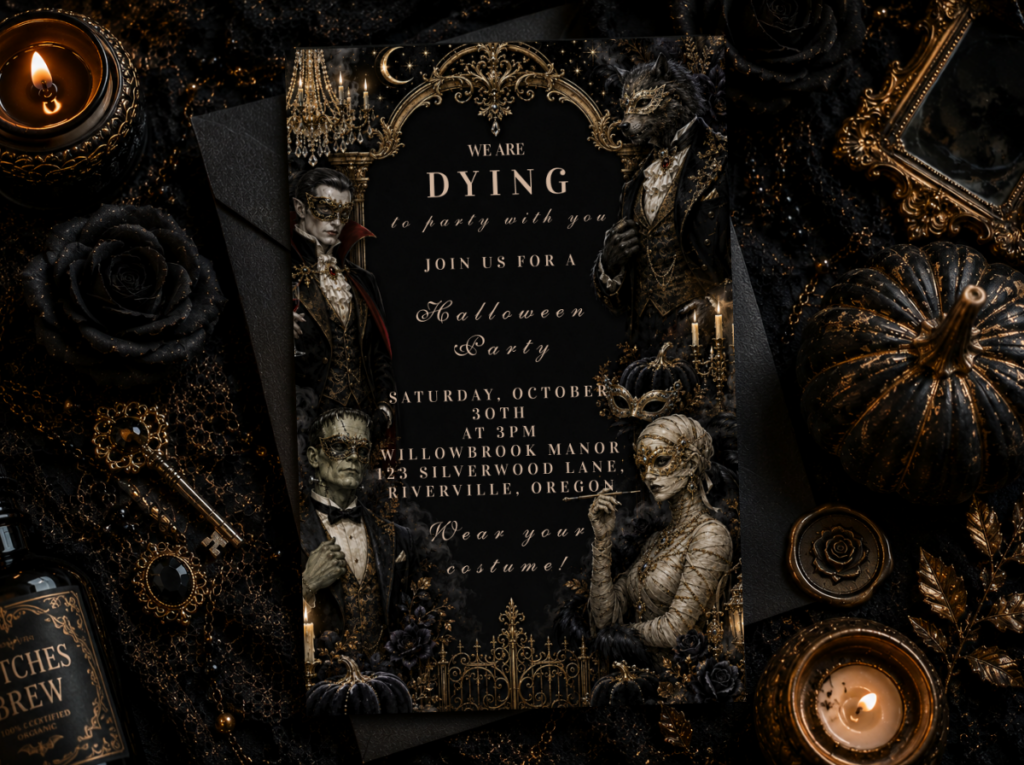
The Monster, Zombie & Haunted Halloween collection carries the character-driven storybook illustration style throughout the full stationery and banner range.
Section 02 Decor, Cake & Table
Every decor element serves the narrative: the room is a haunted house, the creatures are its inhabitants, and every table and surface tells a piece of the story.
Crumbling-mansion-facade backdrop — the photo moment and room anchor
A large-format backdrop that reads as the entrance to a crumbling old house: a flat illustrated or printed facade with a pointed gothic roofline, one lit window (a warm amber light source placed behind a cut-out window shape), a cracked stone texture, and an oversized door slightly ajar. Positioned at the primary wall of the party space as the main backdrop, with the party’s creature characters — a ghost drifting from one window, a stitched monster peering around the door — placed as flat cutout figures at specific positions within the facade. The facade can be assembled from dark card stock, a dark painted sheet, or a printed banner — what matters is the silhouette of the roofline and the one warm amber window as the focal light source. This is the room’s primary photo moment: every guest photograph taken against this backdrop is framed by the haunted house entrance.
Stitched-monster centrepiece — the table’s character anchor
A three-dimensional or standing flat-cutout stitched monster figure (30–45cm tall) placed at the centre of each guest table as the character anchor. The monster is the table’s personality: its expression and posture communicate the party’s playful-spooky register to every guest who sits at the table. Around the monster figure: a cluster of three small dark green or deep purple ceramic votive holders with warm amber candles, and two or three short dried botanical stems in dark tones (dried eucalyptus, dark dried roses). The monster figure stands above the botanical cluster like a character who has been placed in a Halloween centrepiece and is mildly confused about it — which is exactly the tone the monster party direction requires.
Graveyard dessert table with tombstone cookies — the narrative food moment
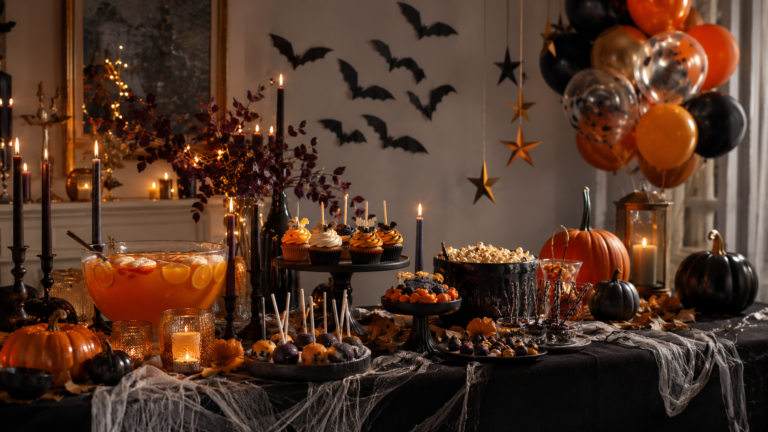
A dessert table styled as a small graveyard: a dark fabric surface (deep forest green or near-black) with small standing tombstone-shaped cookie displays at the back of the table, each tombstone cookie iced with a name and dates in the monster party’s character vocabulary (‘R.I.P. Good Manners,’ ‘Here Lies the Snack Budget,’ ‘Gone but Still Wandering’). At the front of the table: the main dessert items, each with a small character flag or label in the party’s illustration style. The dessert table reads as narrative when the labels and the tombstones tell a running story across the table surface rather than when each element is simply named generically. The story can be as simple as ‘Welcome to the Monster Household’ communicated through the names and labels on each dessert position.
Deep green and purple linen with monster silhouette accents — the table surface
A deep forest green tablecloth as the table base — forest green is the colour most associated with the classic storybook monster aesthetic and communicates the character-driven direction with complete clarity before any figure is placed on the table. A deep purple linen runner down the centre as the accent. Monster silhouette accents: small flat-printed or hand-stamped monster, zombie, and ghost silhouettes placed at intervals down the runner — not at every position, but at three to five points, so that the runner reads as a scene from the haunted house story rather than as a repeating pattern. Dark wooden serving boards for food at the table; deep green or near-black ceramic serving ware as the vessel choice.
🧟 Styling Tip
Limit the cast to three creature types per party — choose zombie, ghost, and one monster type, not five different creatures competing for attention across every table and surface. Three creatures with distinct characters read as a cast; five creatures at equal prominence read as a collection of Halloween props. Each creature should appear multiple times in the same illustration style rather than once in five different styles — repetition of one character across the party space communicates that the character is a presence in the room, not just a decoration element at one table.
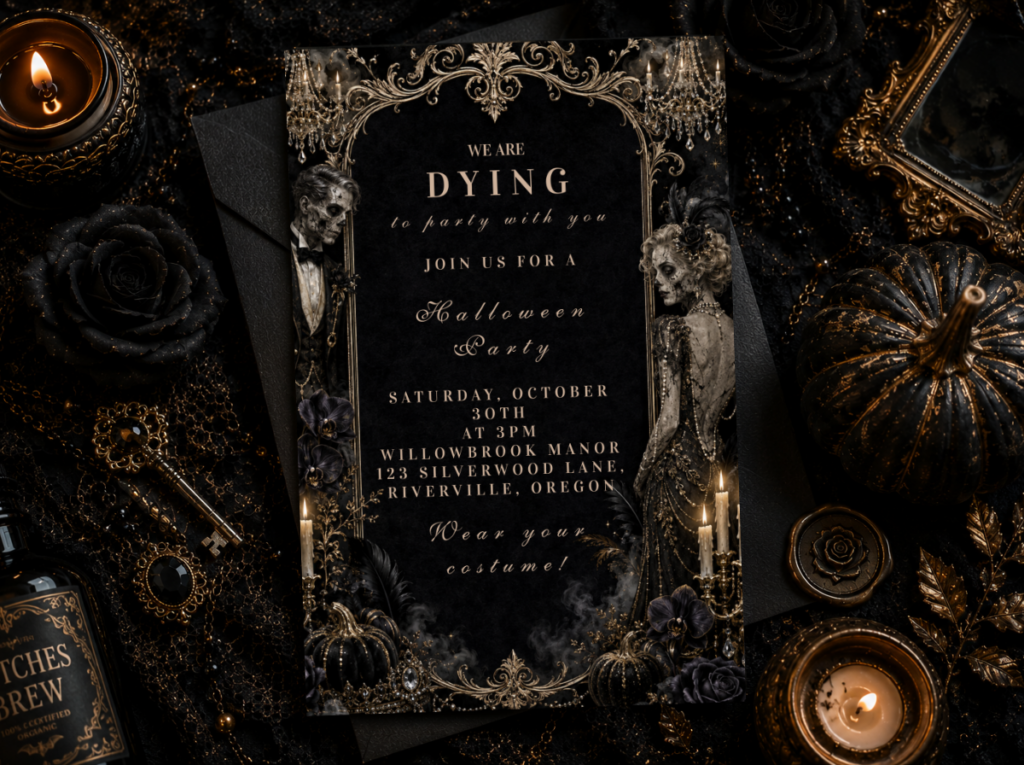
Browse the Monster, Zombie & Haunted Halloween collection for the full character-driven stationery and banner range.
Section 03 Invitations & Party Favours
The monster and haunted house party invitation is the first chapter of the story the party is telling — and it should communicate both the character register (playful-spooky, storybook-illustrated) and the haunted house narrative before any guest has arrived. A mansion-silhouette invitation — a gothic roofline against a dark sky, one lit amber window, a ghost or monster visible at the door — in the party’s deep green, deep purple, and dark tone palette sets the narrative with complete clarity: there is a haunted house, something is living in it, and guests have been invited inside.
The favour tag styled as a haunted mansion admission ticket is the most specifically designed monster party favour tag available — and it costs nothing beyond a printer and a few minutes. ‘Admit One: [Guest Name] / The Monster Household Welcomes You / Haunted House Est. [Year] / Valid for One Night Only.’ The ticket format communicates that this is a specific place with a specific story, and that the guest has been formally admitted to it. It also works as a printed keepsake in a way that a generic favour tag does not, because the narrative gives it a specific identity beyond its function.
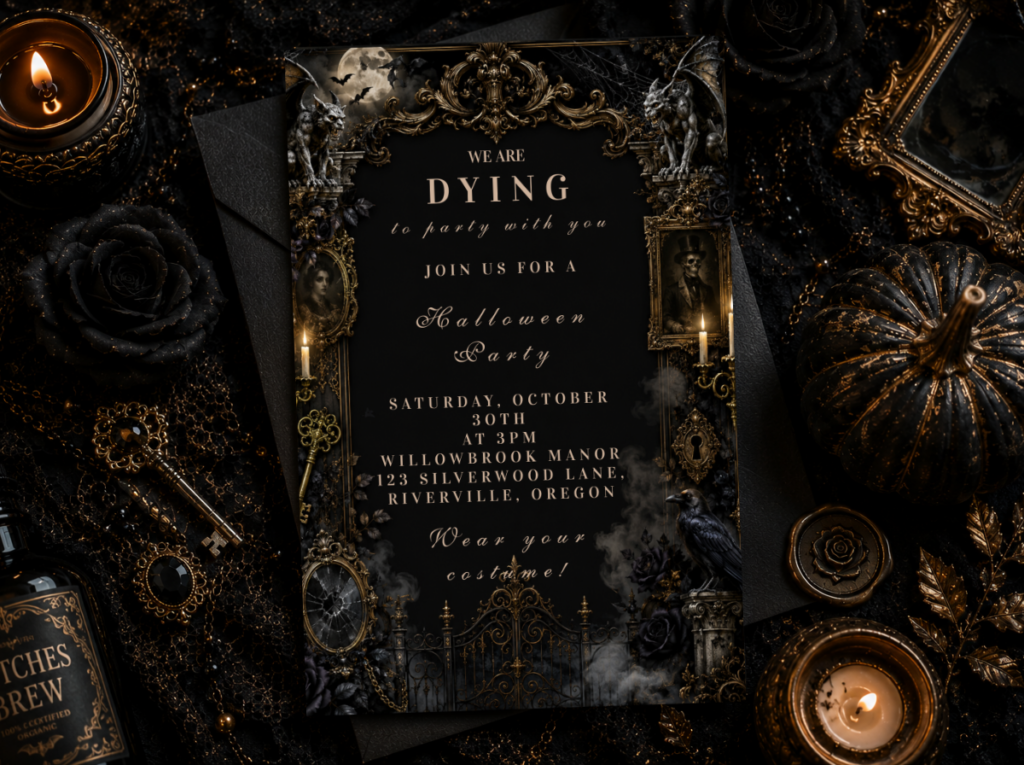
Browse both collections for monster Halloween stationery, including the All Halloween range for broader options.
Frequently Asked Questions
How do I keep this theme fun rather than genuinely scary for younger guests?
The storybook register is the answer — and it is maintained through illustration style rather than through tone. The character-driven monster party reads as fun-spooky for younger guests when every creature illustration follows the storybook principle: flat, simplified, personality-forward, with expression and posture doing the character work rather than graphic detail. A zombie with a lopsided grin and an askew bow tie reads as comic rather than threatening at any age. A ghost with an offended aristocratic expression is funny rather than frightening. The test for any individual element: does it have an expression that communicates a personality? If yes, it belongs to the fun-spooky register. If it has no expression — or if its expression is threatening rather than comic — it has crossed into a different register.
What is the difference between this and the Spooky & Scary direction?
The distinction is atmosphere versus narrative. The spooky and scary direction is atmosphere-first: it starts with darkness and adds restraint, using texture, lighting, and the absence of props to produce a genuinely unsettling environment. The monster and haunted house direction is character-first: it starts with a cast of creatures and builds a world around them, using illustration, narrative, and specific character personalities to produce an environment that reads as a story rather than as an atmosphere. Spooky aims to unsettle; monster aims to delight. Spooky uses restraint; monster uses a cast. Spooky is for adults and older teens; monster works across a wider age range because the playful-eerie register is appropriate for younger guests in a way that the atmospheric direction is not.
How many different creature motifs should one party actually use?
Three maximum — and three only works when each creature appears multiple times in the same illustration style. The three-creature rule: choose one creature for the backdrop zone (the ghost haunting the mansion facade), one for the table centrepiece (the stitched monster), and one for the favour and stationery zone (the zombie on the ticket-format favour tag). Each creature repeats within its zone but does not bleed into the others — so the backdrop is consistently ghost, the table is consistently monster, and the stationery is consistently zombie. This creates a cast of three characters each with a specific territory in the party space, rather than five characters distributed randomly across every surface at diminished individual impact.
The Cast Has Arrived
Monster & Haunted House Party Stationery
Character-driven invitations, mansion-facade banners, and haunted admission-ticket favour tags — the stationery that tells the story before any guest walks through the door.