Masquerade Halloween Party Ideas
Halloween · Masquerade Party Guide
Masquerade Halloween Party Ideas
The Halloween party direction where jewel tones replace novelty orange, a single hero mask replaces the costume shop, and a gala atmosphere replaces the trick-or-treat register entirely.
The masquerade Halloween party is the most formally elegant direction in the entire Halloween party category — and the most completely distinct from every other style in the lineup. It is the only Halloween party direction that borrows its visual vocabulary from black-tie events rather than from costume shops or seasonal decoration aisles. Where other Halloween styles play with horror, nostalgia, or playful excess, the masquerade direction operates at a register closer to a Venetian gala: candlelit, RSVP-driven, jewel-toned, and built around the theatrical mystery of concealed identity. The mask is not the costume — it is the entire design concept.
A halloween masquerade party done correctly reads as an event that happens to fall on Halloween, rather than a Halloween party that happened to choose a masquerade theme. That distinction is what makes it the most memorable of all the Halloween party directions — and it is the hardest to execute generically, because generic execution pulls it toward the costume party register every time.
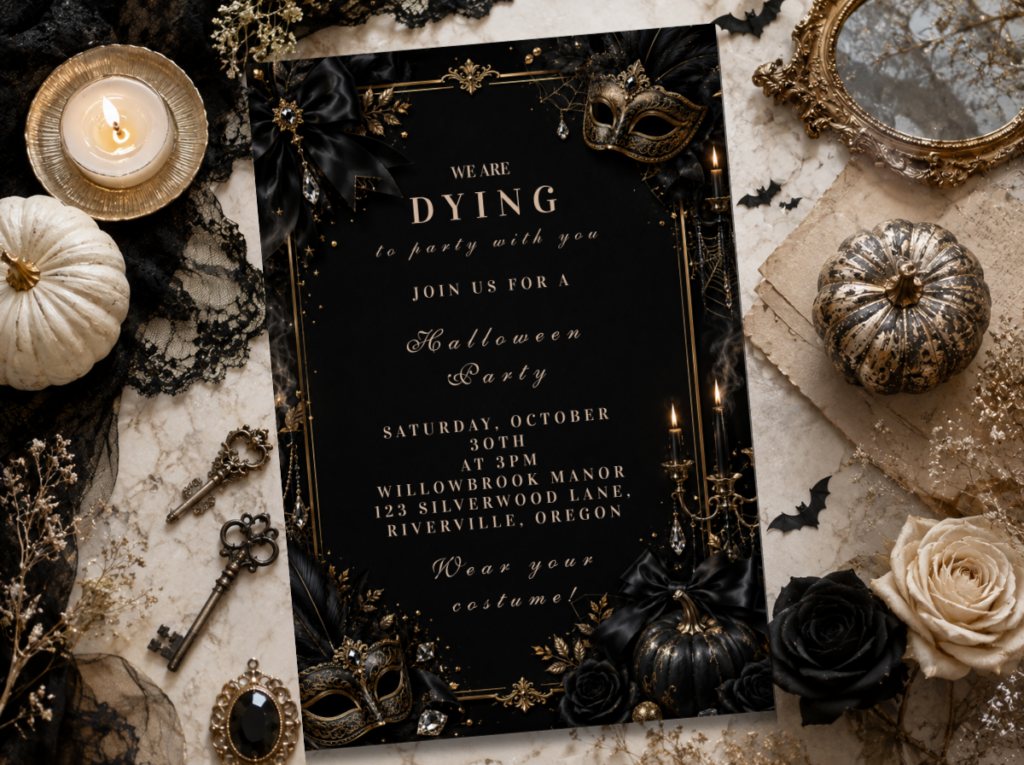
Browse the Masquerade Halloween collection — invitations, programmes, and event stationery in the jewel-tone masquerade palette.
“A party where every face is a mystery until midnight — where the mask is not a costume accessory but the entire premise of the evening, and where the jewel tones of the décor communicate gala, not trick-or-treat.”
Section 01 What Makes a Halloween Masquerade Party Distinct
The masquerade Halloween party occupies a specific and narrow category within the Halloween event space — one that is frequently attempted and rarely executed correctly, because three specific design decisions separate it from a glam Halloween party or a general Halloween costume event. When all three are correct, the masquerade direction reads as immediately and specifically itself. When any one of them drifts toward the generic, the masquerade illusion collapses.
Distinction 1
The Mask Is the Centrepiece, Not a Costume Accessory
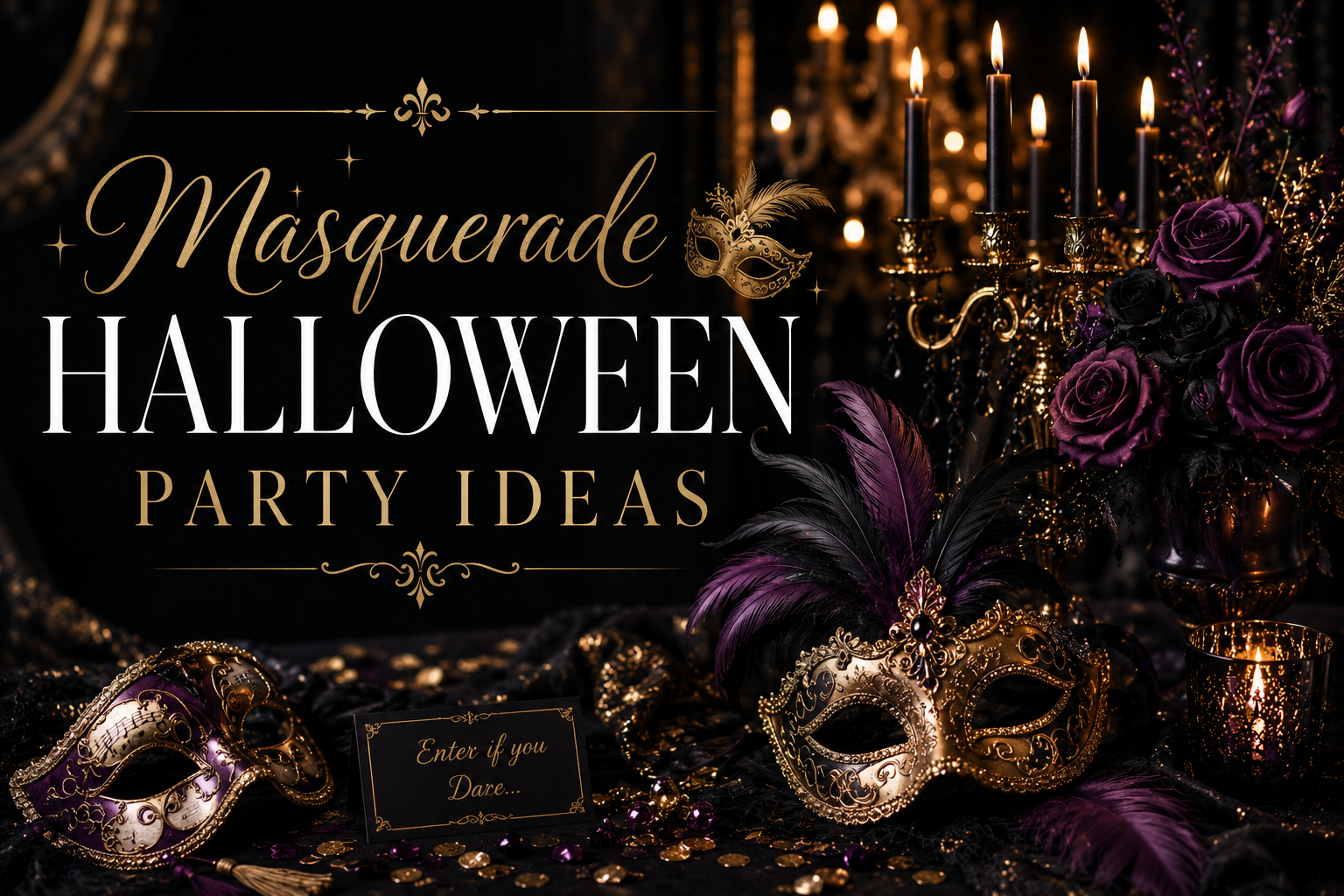
In a standard costume Halloween party, the mask is an element of a costume — something worn alongside other pieces that together communicate a character or a theme. In the masquerade Halloween party, the mask is the entire design concept. A single large, dramatically beautiful Venetian or feathered mask styled as the focal point of an entry table, a fireplace mantel, or a central wall reads as the defining object of the evening. Multiple masks scattered in baskets as favours or placed randomly across decoration surfaces reads as a costume shop display. The masquerade party has one hero mask — perhaps two if the venue is large — treated as you would treat a floral installation or a sculptural centrepiece: with full design attention and a position that makes it the first and last thing guests see.
Distinction 2
Jewel Tones Over Black-and-Orange — Always
The colour palette of a masquerade Halloween party is borrowed from the Venetian carnival and the formal event world rather than from the Halloween commercial colour system. Deep emerald green, rich burgundy, midnight navy, and antique gold are the palette — the specific jewel tones that communicate drama, formality, and mystery simultaneously. Black-and-orange is explicitly the wrong direction: orange reads as novelty Halloween and belongs to a completely different register. Deep black as a base is appropriate; bright orange as an accent is not. The test is simple: would this colour appear at a formal gala? If yes, it belongs to the masquerade direction. If it reads as a seasonal Halloween decoration, it belongs somewhere else.
Distinction 3
Formal Event Styling — Gala, Not Costume Party
The masquerade Halloween party is a seated, RSVP-driven, formally dressed event. It is structured like a gala rather than like a party — which means assigned seating, a formal invitation with a mask motif and a reply card, dress code specification on the invitation (formal attire plus mask required), and an event programme if the evening includes a reveal, a dinner, or a performance element. String lights, plastic decoration, novelty Halloween tableware, and themed paper goods read as costume party rather than masquerade gala. The structural difference between a masquerade and a costume party is precisely this formality — without it, the masquerade direction has no foundation.
🎭 Styling Tip
Style one oversized decorative mask as a focal wall or table piece — not a pile of masks scattered as favours. A single dramatic mask, beautifully lit, placed at a height that guests naturally orient toward, reads as masquerade. A basket of masks beside the entrance reads as a costume-shop display. If masks are to be provided for guests who arrive without one, present each as an individually packaged favour at the place setting rather than as a casual help-yourself selection.
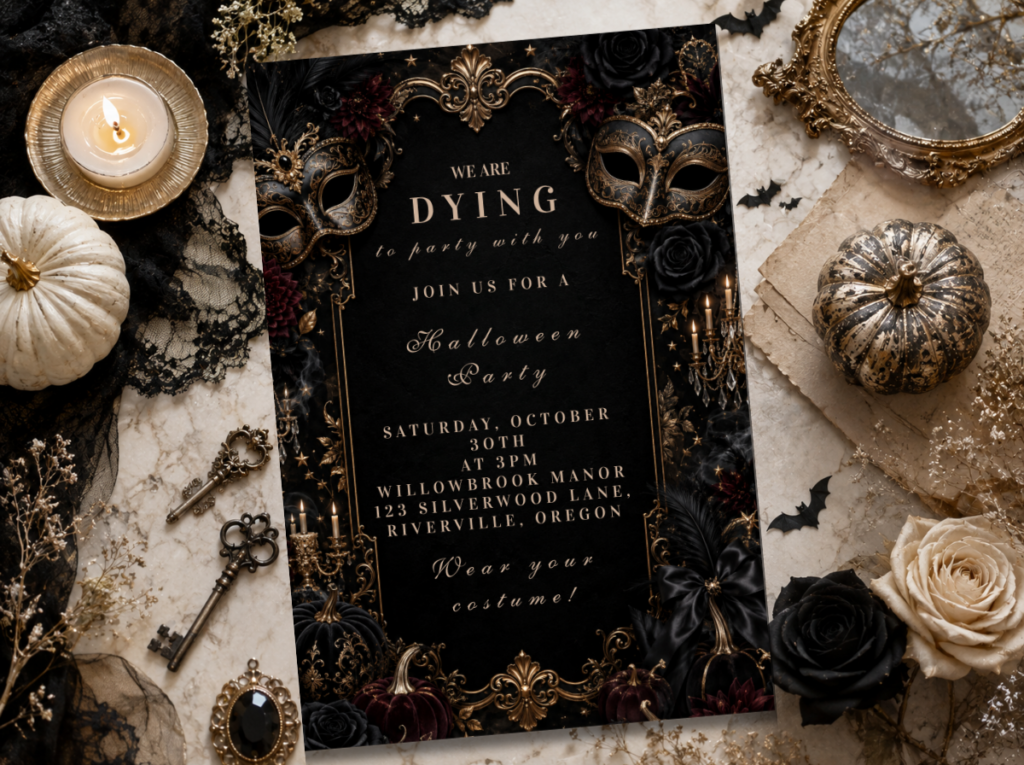
The Masquerade Halloween collection — formal event stationery in the jewel-tone masquerade palette.
Section 02 Décor, Table & Invitations
Every element of a masquerade Halloween party table should pass the formal gala test: would this element appear at a black-tie dinner? If the answer is yes, it belongs. If the answer is no — if it reads as novelty, as seasonal, or as costume-party adjacent — it does not.
Table setting: An emerald green or deep burgundy velvet table runner on black or deep navy linen. Charger plates in antique gold or dark charcoal. Tall taper candles in deep black or ivory candlesticks at varying heights — three heights minimum, so the candlelight creates a layered illumination across the table surface. Black or deep emerald napkins folded formally and placed on the charger. Antique gold or aged brass flatware. The table should read as theatrical and formal simultaneously — the drama comes from the colour depth and the candlelight, not from any novelty decoration element.
Centrepiece: A feathered floral arrangement in deep jewel tones — deep burgundy florals, black feather sprays, deep emerald foliage — as the primary centrepiece, with the hero mask positioned either at the centre of the arrangement or as its own elevated focal piece on a small stand or easel beside the floral. The centrepiece communicates the masquerade direction through drama and formality rather than through novelty: no plastic skulls, no novelty Halloween tableware, no orange-and-black colour anywhere in the arrangement.
Invitations: A formal masquerade Halloween invitation carries the mask motif as the primary illustration — not as a clip-art element but as the architectural centrepiece of the design, in the jewel-tone palette of the event. A wax seal in antique gold or deep burgundy on the envelope, or a ribbon detail in the event palette tied around the invitation suite, communicates the formal register before the envelope is opened. The invitation wording follows formal event convention: dress code specification, RSVP deadline, and the event name presented as a proper event title rather than as a casual party announcement.
🎭 Styling Tip
Hold every colour choice against one question: would this belong at a formal gala? If an element reads as novelty-store Halloween — bright orange, plastic, novelty-shaped — it breaks the masquerade illusion immediately. This theme borrows its visual language from black-tie styling rather than from trick-or-treat styling. Every element that passes the gala test strengthens the masquerade direction; every element that fails it undermines it, regardless of how well-executed it is individually.
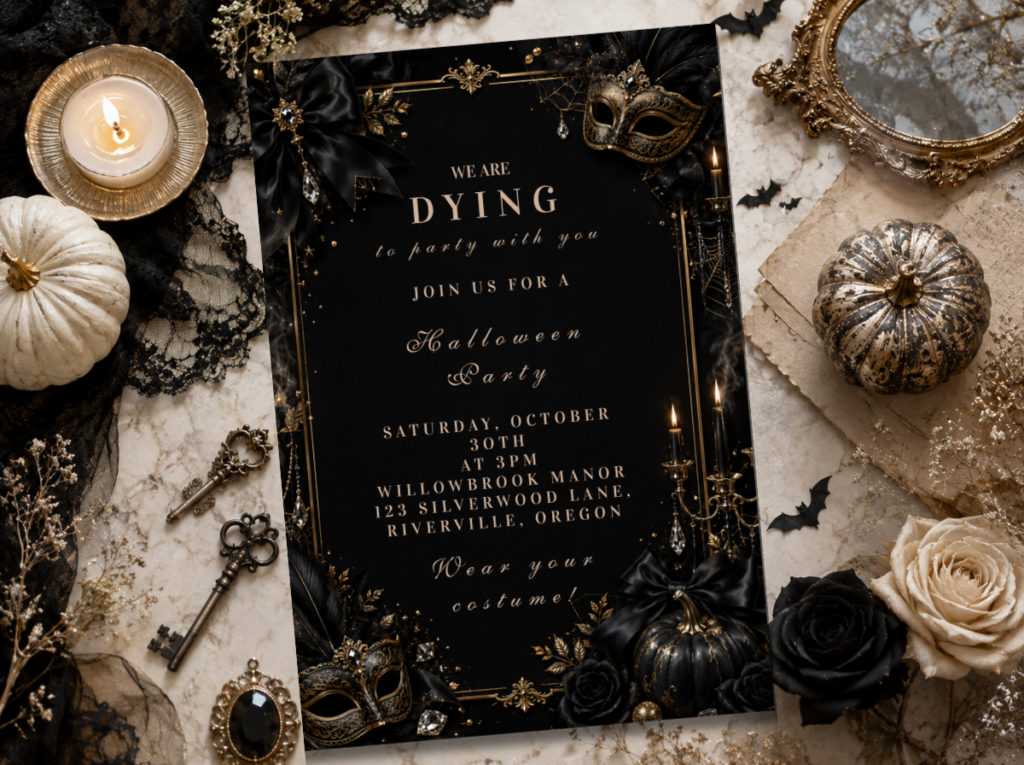
The Masquerade Halloween collection — formal invitation suites and event stationery in the jewel-tone masquerade palette.
Section 03 Making It Feel Formal, Not Costume Party
The structural decisions — seating, lighting, sound, and event flow — are what maintain the masquerade atmosphere across the full duration of the evening. A beautifully decorated room with a costume-party atmosphere inside it reads as a decorated room rather than as a masquerade event.
Seating and RSVP: Assigned seating with formal place cards — a small mask motif printed or embossed on each place card in the jewel-tone palette. A formal RSVP process rather than an informal response — a reply card with an envelope, a formal digital RSVP, or a wax-sealed response card. The RSVP process communicates the event’s register to guests before they arrive: a formal invitation with a formal reply requirement arrives at a formal event. An informal ‘let me know if you’re coming’ response process arrives at a casual party.
Lighting: Candlelight as the primary light source at the table level, with ambient lighting set to the lowest comfortable level for the room. String lights are the wrong choice for the masquerade direction — they read as festive and casual rather than as theatrical and formal. Floor candelabras or tall pillar candle arrangements at the room perimeter provide the ambient light level that the masquerade atmosphere requires. The specific quality of candlelight — warm, flickering, directional — amplifies the jewel tones of the décor and creates the specific theatrical atmosphere that the masquerade direction is built on. No overhead fluorescent or bright LED lighting visible at any point in the evening.
Sound: Live acoustic music or a carefully curated ambient playlist — classical, baroque, or dramatic instrumental — at a volume that allows conversation without effort. A live string quartet or a solo pianist for the most formally executed version; a recorded baroque or dramatic classical playlist as the minimum. The sound level and the sound register are both part of the formal atmosphere: a masquerade event at which guests must raise their voices to be heard, or at which contemporary pop music plays at party volume, reads as a costume party that borrowed some decorative elements from the masquerade direction.
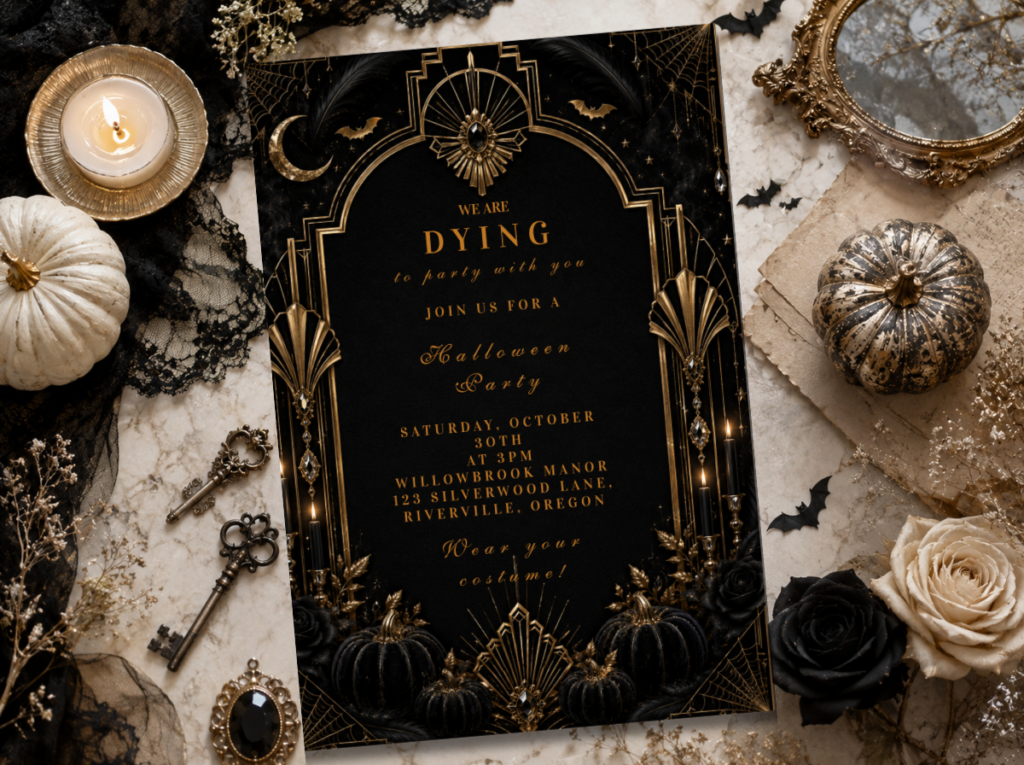
Explore the full Halloween party stationery range for every direction from masquerade to monster to neon glow.
Frequently Asked Questions
How is a masquerade Halloween party different from a regular costume party?
Three structural differences separate the masquerade Halloween party from a standard Halloween costume event. First, the mask is the design concept rather than a costume component — guests are formally dressed and masked rather than costumed. Second, the event is formally structured: assigned seating, a formal invitation with a reply requirement, and a dress code specification rather than an open invitation to wear any Halloween costume. Third, the atmosphere is theatrical and formal rather than casual and festive — candlelight over string lights, jewel tones over novelty orange-and-black, and a sound register that allows conversation rather than amplifying it. A costume Halloween party is a casual social event with themed decoration. A masquerade Halloween party is a formal event with a theatrical premise.
What colours work best for a masquerade Halloween party?
Deep emerald green, rich burgundy, midnight navy, and antique gold are the masquerade Halloween palette — the jewel tones borrowed from Venetian carnival and formal event design rather than from the seasonal Halloween colour system. Deep black as the base is appropriate and dramatically effective. Bright orange is explicitly wrong for this direction: it belongs to the novelty Halloween register and reads as a thematic conflict at a masquerade event. Gold is the accent metal; silver or bright chrome reads as too contemporary and too cool beside the warmth of the jewel tones. The test for every colour choice: would this appear at a formal gala? If yes, it belongs. If it reads as seasonal Halloween decoration, it does not.
Does everyone need to wear a mask the whole evening?
The mask is required for the formal portion of the evening — the arrival, the formal dinner or gathering, and any theatrical element such as a midnight reveal. Guests should be informed in the invitation that masked attendance is required for the event’s formal duration, with the option to remove masks after a specified time (midnight is the traditional reveal moment in masquerade tradition). Providing individual mask favours at each place setting ensures that guests who do not own a formal mask arrive prepared. The quality and style of the provided masks should match the formal register of the event — individually packaged, feathered or jewel-detailed, in the event’s palette — rather than appearing as a collective costume-shop purchase.
Every Face a Mystery Until Midnight
Shop the Masquerade Halloween Collections
Formal masquerade Halloween party stationery — invitations, place cards, and event programmes in the jewel-tone masquerade palette.