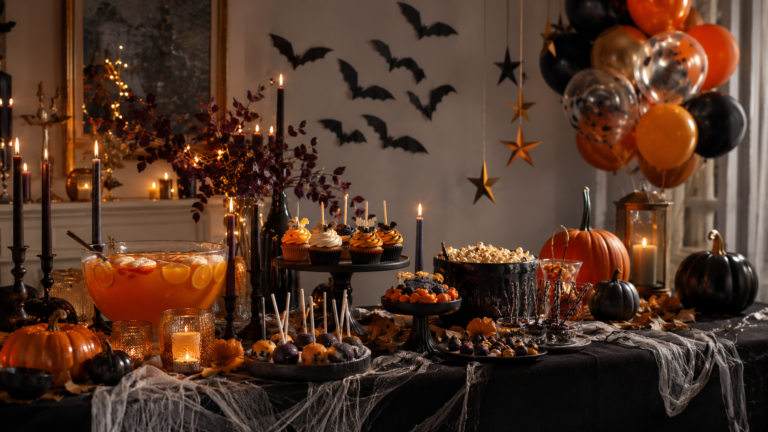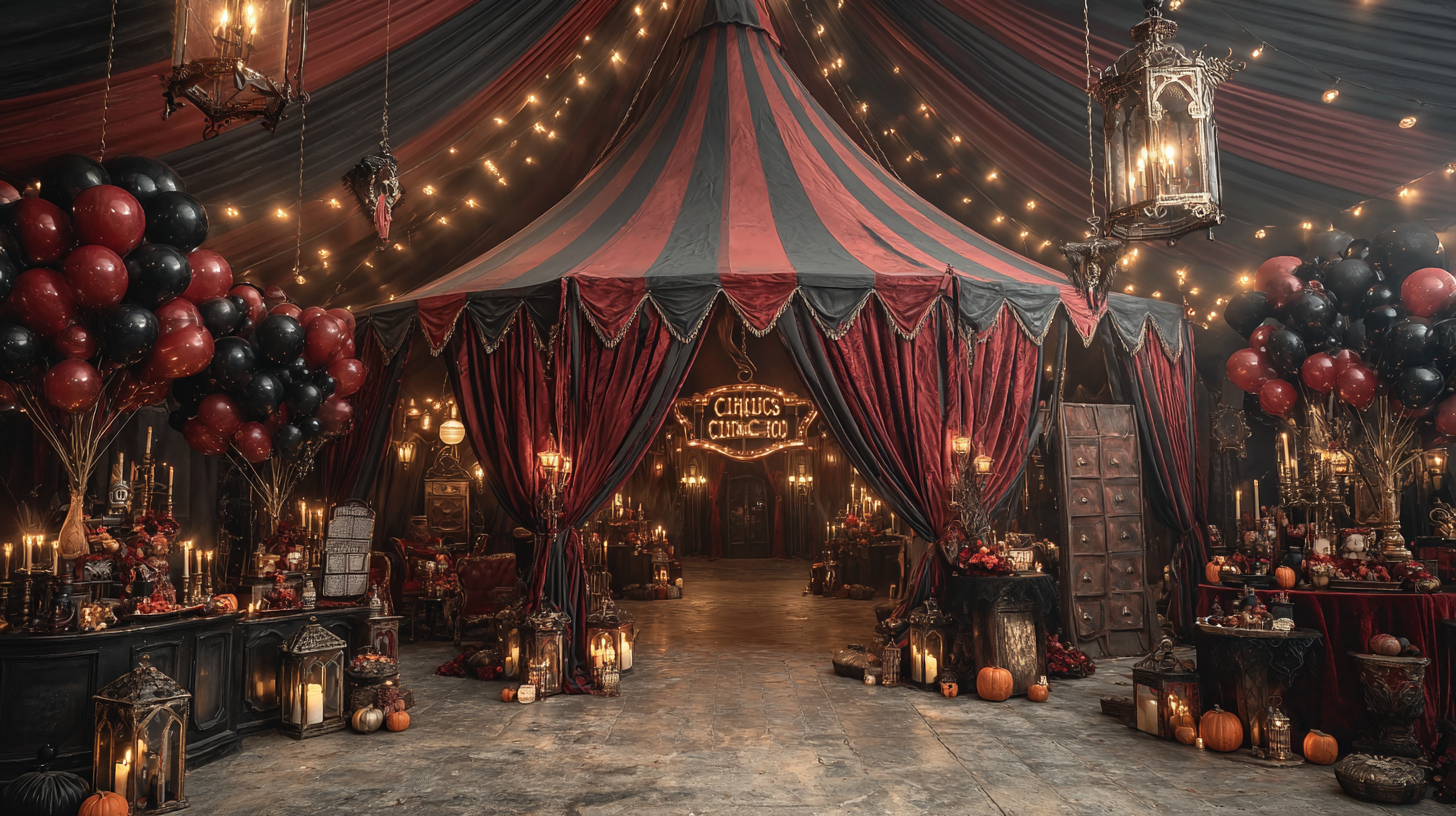
Circus & Carnival Halloween Party Ideas
Halloween · Circus & Carnival Party Guide
Circus & Carnival Halloween Party Ideas
The tent-stripe pattern, the carnival-game station, and the warm nostalgic atmosphere that make a circus Halloween party look specifically designed rather than generically festive.
The circus Halloween party is the most searched Halloween party style in the entire lineup — and the most frequently executed generically. The gap between a beautifully designed circus and carnival Halloween party and a generic orange-striped birthday-party-adjacent event is not one of budget or production quality; it is one of design discipline. The tent-stripe pattern, repeated consistently across the backdrop, the table runner, and the favour bags. The carnival props that do the visual work instead of Halloween icons. The warm, amber-lit fairground atmosphere that communicates Halloween through colour and lighting rather than through pumpkins and cobwebs.
When those three decisions are made correctly, the circus and carnival Halloween party reads as something that could not have happened on any other date: the nostalgia of the travelling fairground and the excitement of Halloween occupying the same warm, striped, popcorn-scented space simultaneously. That convergence is the specific quality of this direction — and it cannot be produced by adding a Halloween banner to a generic circus room.

Browse the Circus & Carnival Halloween collection — vintage fairground party stationery in the tent-stripe palette.
“The circus rolled into town, and it brought Halloween with it — the tent-stripe canopy, the warm amber lights, the smell of popcorn, and the specific October chill that makes the carnival atmosphere something entirely different from any other month of the year.”
Section 01 What Makes Circus & Carnival Distinct
Three specific decisions separate a genuinely designed circus Halloween party from a generic striped party that happens to fall in October. Each targets a different layer of the design: the surface pattern, the prop selection, and the atmospheric register.
Distinction 1
The Tent-Stripe Pattern as the Design Backbone
The circus and carnival Halloween party is anchored by the tent-stripe pattern in the same way that a tartan anchors a Scottish theme or a toile anchors a French country direction: the pattern is not an accent, it is the primary visual vocabulary of the entire event. Cream and burnt orange canopy stripes — vertical, bold, and consistently scaled — appear on the backdrop, the table runner, the favour bags, and the invitation simultaneously. When the stripe appears on three or more surfaces in the same scale and the same proportion, the room reads as ‘circus’ immediately and completely. When the stripe appears on one surface and is absent from the others, the room reads as a striped party rather than as a specifically circus Halloween direction. The stripe must repeat; repetition is the design decision.
Distinction 2
Carnival Props Over Halloween Props
The circus and carnival Halloween party communicates the Halloween occasion through its atmosphere and its palette rather than through traditional Halloween props. Popcorn cups, ticket stubs, pennant flags, funnel-cake stands, and ring-toss game props do the visual work of establishing the carnival world — and within that world, Halloween arrives through the amber-and-black palette and the late-October timing rather than through pumpkins, cobwebs, or skeleton decoration. This does not mean Halloween props are forbidden: a carved pumpkin on the popcorn counter, a ghost pennant in the flag garland, or a skeleton silhouette on a ticket-stub favour card all work within the carnival visual language without breaking it. The difference is that these Halloween elements are accents within the carnival world rather than the primary decoration layer.
Distinction 3
Warm and Inviting — Not Spooky or Haunted
The register of the circus and carnival Halloween party is festive nostalgia rather than horror or fear. This is a critical distinction from the Spooky and Scary direction, which uses atmosphere and fright as its primary tools, and from the Haunted House direction, which aims at the unsettling. The circus and carnival Halloween party aims at warmth and joy — the specific warmth of amber carnival lights, the joy of a ring-toss game, the nostalgia of a popcorn smell in cold October air. Fog machines, horror-movie props, and jump-scare staging belong to a different Halloween party style entirely. The circus and carnival direction should feel like the best part of Halloween — the communal, joyful, slightly magical part — rather than the frightening part.
🎪 Styling Tip
Let the tent-stripe pattern repeat across at least three surfaces — backdrop, table runner, and favour bags at minimum. That repetition is what makes the room read as ‘circus Halloween’ rather than as ‘orange striped party.’ One striped element in an otherwise unstriped room reads as an accent. Three striped surfaces in the same scale and proportion read as a fully committed aesthetic direction. The stripe is the design; everything else builds on it.
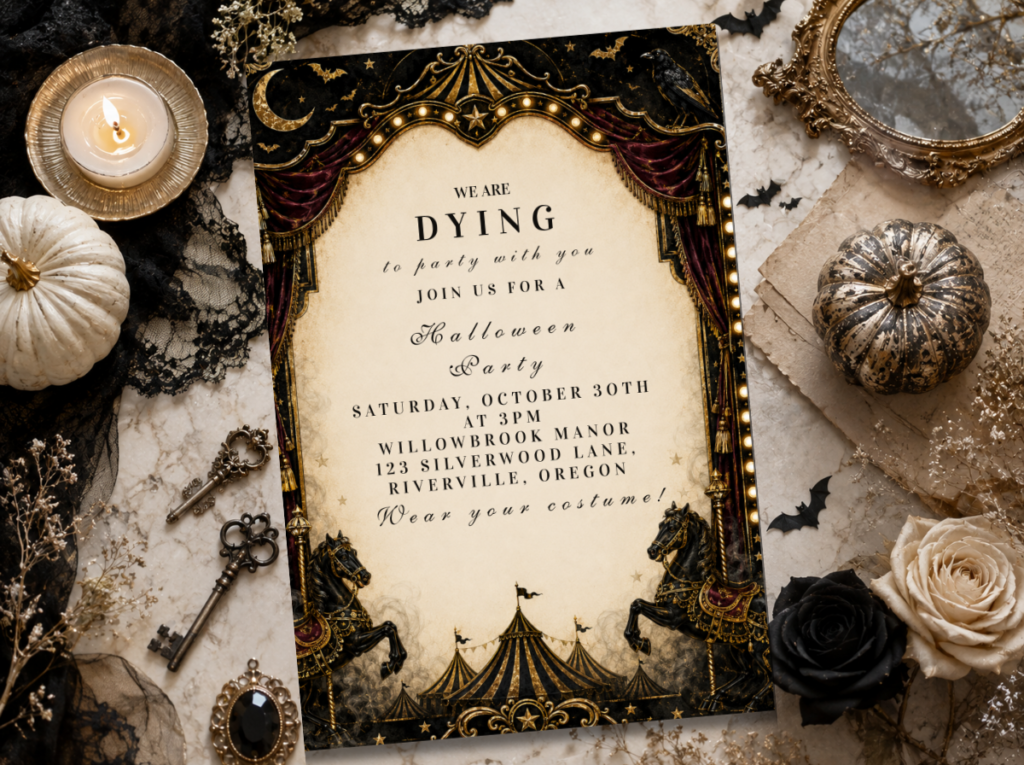
The Circus & Carnival Halloween collection — vintage fairground stationery in the tent-stripe palette.
Section 02 Décor, Cake & Table
The circus and carnival Halloween table is built in layers: the stripe as the surface pattern, the carnival props as the mid-level visual interest, and the warm amber lighting as the atmosphere layer that activates both.
Canopy backdrop — the room’s primary visual anchor
A vertical cream-and-burnt-orange stripe backdrop at the designated photo zone — either a fabric canopy in the tent-stripe proportion, a printed vinyl backdrop, or a striped balloon mosaic in cream and rust as an alternative. The backdrop establishes the circus register for the entire room; every prop and every table element reads within the context the backdrop has created. Without a stripe backdrop, the room requires significantly more work from individual props to communicate the circus direction. With it, even minimal additional decoration reads as specifically and intentionally circus Halloween.
Table scatter — popcorn cups, ticket stubs, pennant flags
Vintage-style popcorn cups in the stripe palette as table vessels — used to hold napkins, cutlery, or small sweets rather than as popcorn containers, so that the visual of the popcorn cup reads as a designed table element rather than as food service. Miniature ticket-stub cards in cream and rust scattered along the table runner as the flat confetti layer — ‘Admit One’ or ‘Step Right Up’ printed in vintage slab-serif typeface. A pennant flag garland in cream, rust, and black strung above the table or across the backdrop as the overhead element — alternating stripe and solid pennants in the three-colour palette. These three prop types — popcorn cup, ticket stub, pennant — are the minimum carnival prop set for the table; all three together communicate the carnival world with complete clarity.
Cake — striped fondant band on cream buttercream
A two or three-tier cake in warm cream buttercream with a single striped fondant band at the base of the top tier — cream and rust or cream and black vertical stripes in the tent-stripe proportion, narrow enough to read as a decorative band rather than as the full cake surface. A pennant flag topper — a small triangular flag in the stripe pattern on a wooden skewer — as the cake’s primary decoration. Warm cream as the dominant buttercream colour rather than white — the specific warm quality of cream alongside rust and black reads as vintage carnival; bright white beside the same colours reads as contemporary and slightly clinical. One small carved pumpkin or pumpkin-shaped fondant detail at the cake base as the optional Halloween accent.
Lighting — amber warmth as the Halloween signal
Warm amber string lights or Edison bulb strings as the primary decorative lighting layer — strung across the ceiling, around the backdrop frame, or along the table edge. The specific amber quality of warm incandescent or vintage Edison lighting is the single most atmospheric element of the circus Halloween direction: it communicates both the fairground (warm carnival lights in the dark) and Halloween (amber is the primary Halloween atmospheric colour) simultaneously. No cool-white LED string lights; these read as contemporary and break the vintage fairground atmosphere. Deep orange uplighting at the room perimeter as the secondary lighting layer, visible behind the backdrop and beneath the table edges.
🎪 Styling Tip
Keep the stripe scale consistent across every surface where it appears — wide stripes on the backdrop mean wide stripes on the table runner and wide stripes on the favour bags. Mixing narrow and wide stripes across different surfaces reads as mismatched rather than as a coordinated stripe direction. The specific width of the stripe is less important than its consistency: thin and consistent reads as designed; thick backdrop stripe beside thin runner stripe reads as two separate prop decisions placed in the same room.
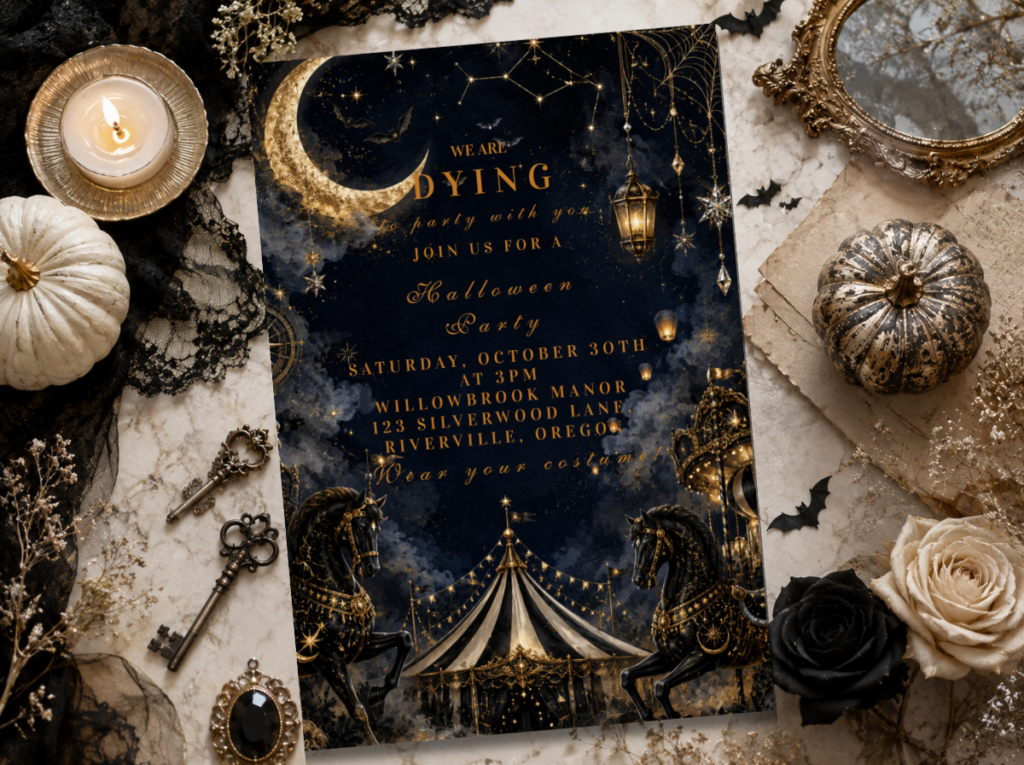
The Circus & Carnival Halloween collection — tent-stripe party stationery for the vintage fairground Halloween direction.
Section 03 Activities & Invitations
The circus and carnival Halloween party is the second most activity-natural Halloween format after the classic icons pumpkin party — because carnival games are inherently participatory, scale-flexible, and appropriate for a wide age range simultaneously.
Carnival game stations: Two or three game stations produce the right amount of activity energy for a Halloween carnival party without overwhelming the decoration or the food area. A ring-toss station — a set of rings and a target of bottles or wooden pegs in the stripe palette — is the most universally recognisable and the most easily set up of all carnival games. A ‘duck pond’ variation with rubber ducks wearing miniature witch hats or tiny skeleton prints communicates the Halloween connection within the game format. A ‘fortune teller’ corner — a small decorated table with a crystal ball prop, a deck of cards, and an atmospheric candle — as the single atmospheric element that nods toward the Halloween-specific register without requiring a horror staging. Small prizes in stripe-palette packaging at each station as the take-home favour component.
Invitations: The circus and carnival Halloween invitation in the ticket-stub format is the most thematically consistent option — a rectangular card in the proportion of an admission ticket, with ‘Admit One’ in vintage slab-serif typeface in the header, the event details in the main body, and a perforated or printed tear-line detail as the design accent. The stripe pattern appears as the ticket’s border or background wash. The wording in the carnival-announcement register: ‘You Are Cordially Invited to the Greatest Halloween Carnival’ or ‘Step Right Up for a Halloween to Remember.’ The ticket format communicates that this is a specific event with a specific admission moment — which sets the register of the party before the guest arrives.
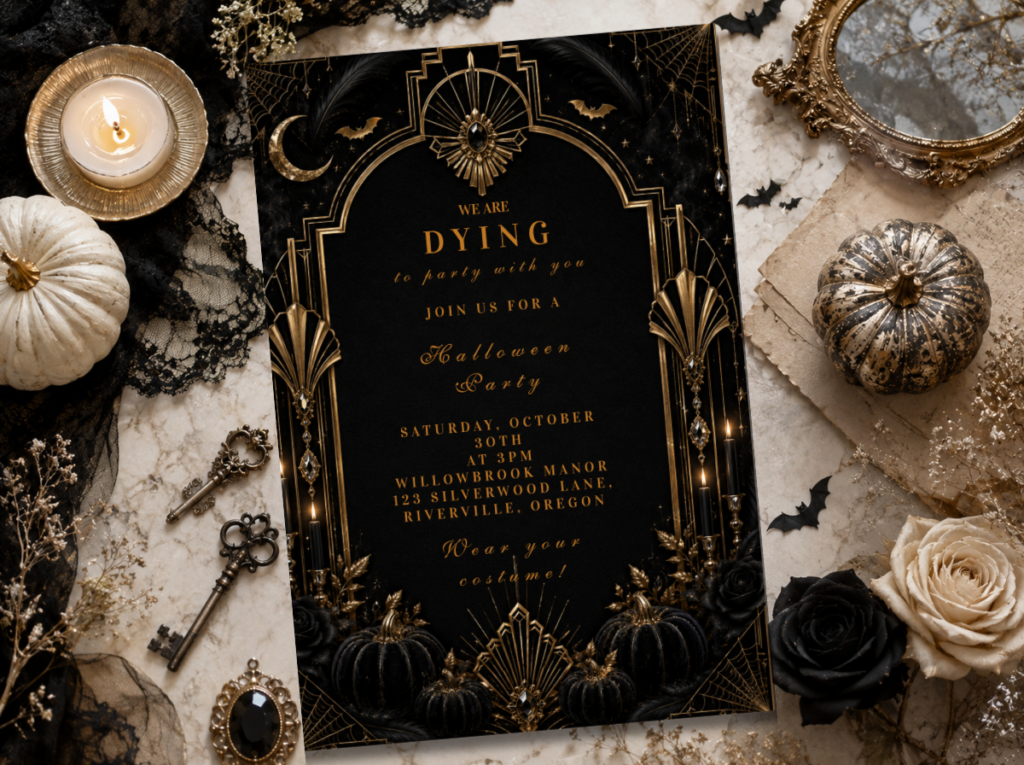
Browse the full Halloween party stationery range for every direction — circus, clown, monster, glam, dark and moody, and more.
Frequently Asked Questions
How do I make a circus party feel like Halloween and not just a birthday circus party?
Three decisions together produce the Halloween-specific quality within the circus aesthetic. First, the palette: burnt orange and warm amber are the Halloween-signalling tones within the cream-and-stripe base palette — a cream-and-blue or cream-and-green circus stripe reads as birthday circus; cream-and-burnt-orange reads as Halloween circus. Second, lighting: warm amber string lights and amber uplighting communicate the October-fairground atmosphere rather than the daytime birthday-party atmosphere. Third, one or two Halloween-specific prop accents within the carnival world — a carved pumpkin on the popcorn counter, a ghost pennant in the flag garland, skeleton-print ticket stubs — carry the Halloween signal without requiring generic Halloween decoration to dominate the carnival aesthetic. The Halloween identity arrives through palette and lighting first; the Halloween props are confirmation, not the primary signal.
What activities work best for a carnival-themed Halloween party?
Ring toss, duck pond, and a fortune teller corner are the three that work most reliably across all ages and group sizes. Ring toss is universally recognisable, physically active, and requires no explanation; it produces the specific sound and social energy of a carnival game immediately. The duck pond variation with Halloween-themed ducks is the most appropriate activity for younger children. The fortune teller corner is the most atmospherically Halloween-adjacent of the three — it produces a quiet, one-on-one moment that contrasts with the energy of the game stations and gives the party a specific texture that a purely game-focused event does not have. For adult-only parties, a card-reading station or a Halloween-themed trivia game in carnival-quiz format works within the same aesthetic register without requiring physical game setup.
Does a circus Halloween party work for adults, or is it primarily for children?
The circus and carnival Halloween direction works for adults — and for mixed-age groups — as effectively as for children, because the vintage fairground aesthetic appeals to adult nostalgia as much as to childhood excitement. The specific visual language of this direction — the weathered carnival poster, the amber string light, the ticket-stub invitation — is more strongly associated with adult nostalgia than with contemporary children’s entertainment. For an adult-only carnival Halloween party, the adjustments are minimal: game prizes become artisan food or drink items in stripe-palette packaging rather than children’s toys; the food and drink menu shifts toward carnival-inspired cocktails and adult food rather than candy and popcorn; and the fortune teller corner operates as a genuine social experience rather than as a novelty activity. The stripe, the amber lighting, and the carnival props work identically at both age registers.
Tent Stripe · Carnival Props · Amber Lights
Shop the Circus & Carnival Halloween Collections
Vintage fairground Halloween party stationery in the tent-stripe palette — ticket-stub invitations, pennant flag garlands, and popcorn-cup favour packaging.