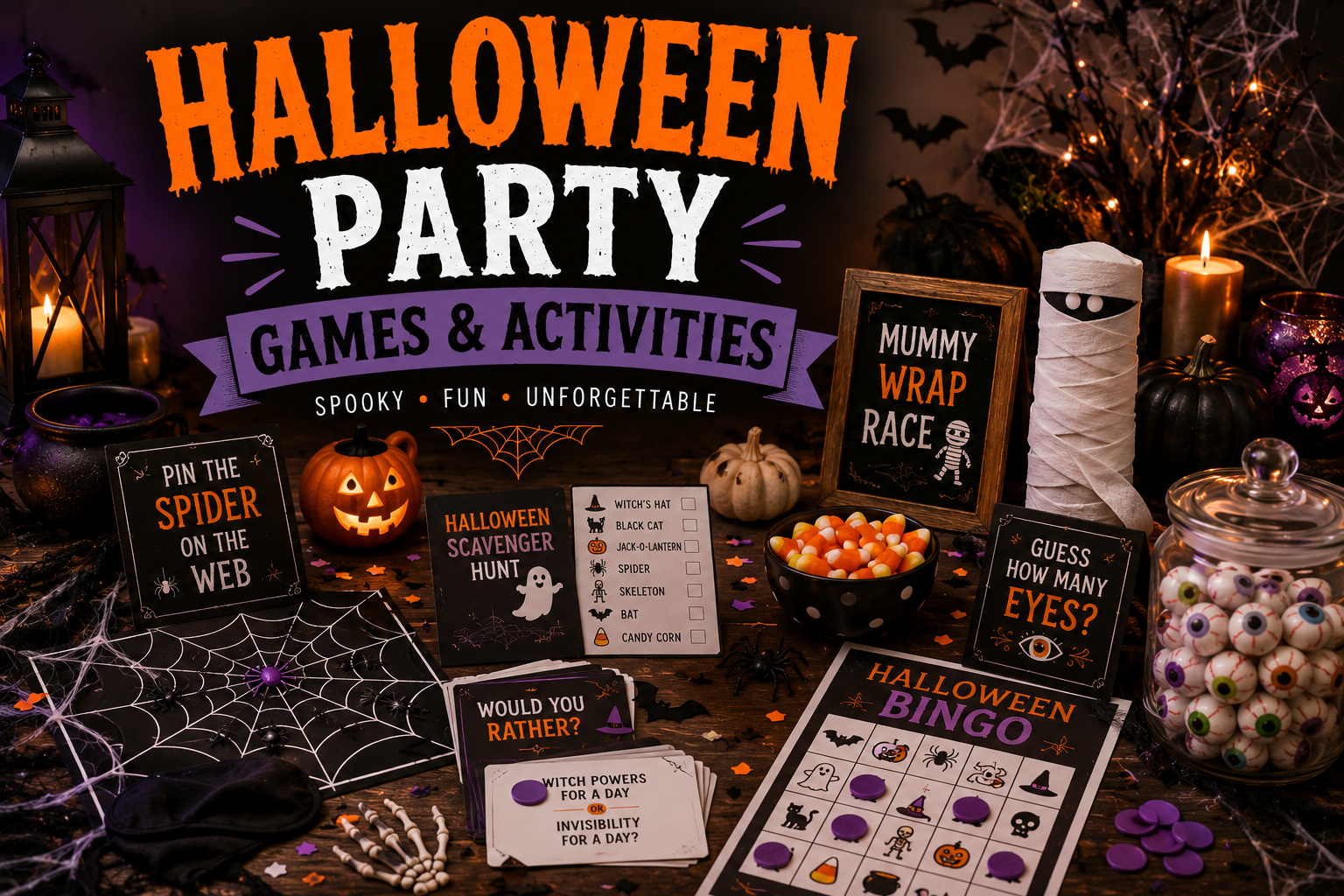
Halloween Party Games & Activities
Halloween · Party Games & Activities Guide
Halloween Party Games & Activities
Halloween games for kids, adults, and teens — each section organised by age group with setup notes, player counts, and the timing guidance that keeps every game running at its best.
The games and activities at a Halloween party are what guests remember and talk about the next day — not the decoration, not the food, and rarely the music. A well-chosen game produces the specific shared-experience energy that turns a group of guests into a party. A poorly chosen game — one that runs too long, requires too much explanation, or is pitched at the wrong age group — produces the specific awkward silence that no amount of decoration can recover.
The sections below are structured by audience: kids, adults, and teens and school/classroom groups. Mixing games from different sections at a single-audience party usually produces the worst results — an adult game at a children’s party bores or confuses; a children’s game at an adult party is occasionally charming but more often awkward. Match the game to the audience; adjust the prize or the forfeit level to the age group; keep every game within its natural time window.
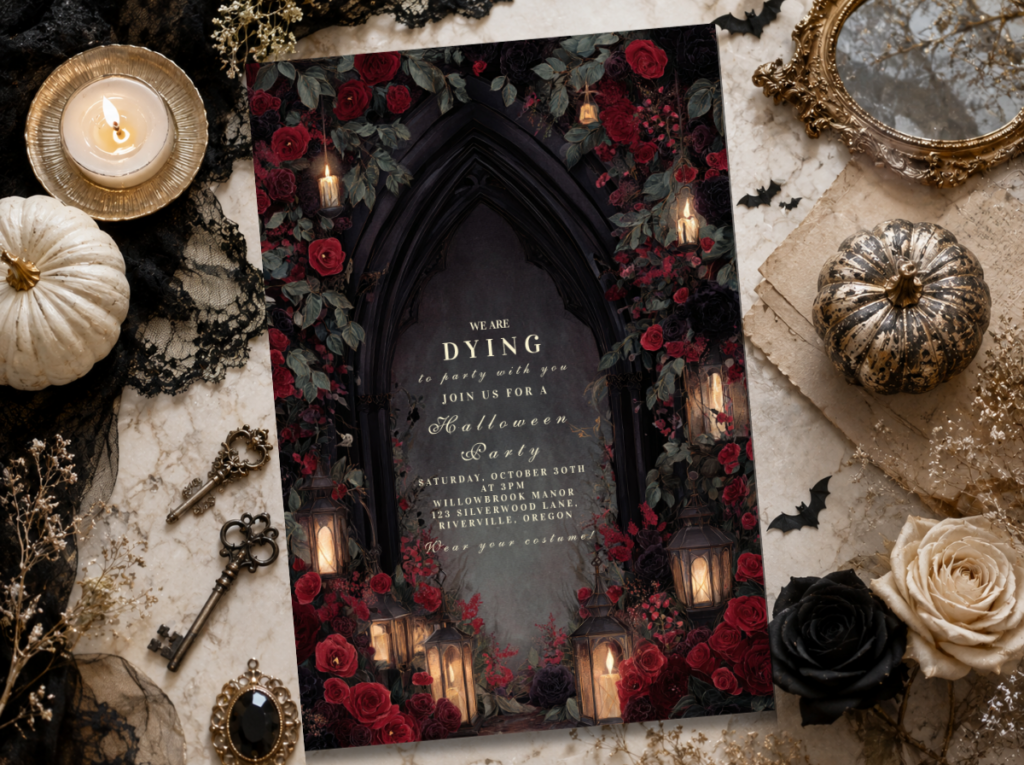
Browse the All Halloween stationery collection — invitations, game cards, and party prints for every Halloween party format.
“The games are what guests actually talk about the next day — not the decoration, not the food. A well-run game produces the shared-experience energy that turns a room of guests into a party. A poorly run one produces the silence that nothing else can fix.”
Section 01 Halloween Party Games for Kids
The best Halloween party games for children share three qualities: they have a clear start and a clear end, they produce a winner or a completion moment that children can see, and they require no more than thirty seconds of explanation before play begins. Open-ended creative activities and games without a resolution moment are consistently the ones that fall apart in a children’s Halloween party context — children disengage quickly without a goal they can orient toward.
🎃
Pumpkin Bowling
4–12 players · Ages 3+ · Prep: 10 minutes · Duration: 10–15 minutes
Ten plastic bottles or cardboard tubes decorated as ghosts, skeletons, or pumpkins arranged in a bowling-pin formation at one end of a clear floor space. A small round pumpkin (or an orange ball in a pinch) as the bowling ball rolled from a designated line. Standard bowling scoring or simplified ‘knock all down in fewest rolls’ format. Children who knock all ten down receive a small prize — a handful of wrapped sweets, a small Halloween sticker sheet. The physical activity, the noise of the falling pins, and the clear resolution moment (all down or not) make this the most reliably successful game for children aged three to eight at any Halloween party. Requires no supervision beyond initial setup and the rule that players stay behind the throwing line.
🧻
Mummy Wrap Relay
6–20 players · Ages 5+ · Prep: 2 minutes · Duration: 10–12 minutes
Players divide into teams of two or three. One player in each team is designated the mummy; the others wrap them from head to toe (leaving a gap for the face and any breathing concern) using a full roll of white toilet paper or crepe paper. The team that uses the full roll first and produces the most complete mummy wins. Judge on speed (first to finish) or quality (best coverage) and announce clearly before play begins. Award a team prize rather than an individual one — shared prizes produce more positive group energy than individual prizes at this age. A simple photograph of each completed mummy before the wrapping comes off gives children a take-home memory. The game runs best with a count-down start and a designated referee who calls ‘stop’ at the finish.
🍬
Candy Scavenger Hunt
Any number · Ages 4–11 · Prep: 15–20 minutes · Duration: 15–20 minutes
Wrapped sweets or small Halloween prizes hidden around the party space before guests arrive — visible enough for younger children (five to seven years old) to find without frustration, slightly more concealed for older children (eight to eleven). Each child given a small decorated bag or bucket at the start. Play continues until all hidden items are found or a time limit is reached. To prevent imbalance between faster and slower finders, use a limit of ‘maximum eight items per child’ to keep the hunt active for everyone rather than allowing one child to collect the majority. A group bonus — an extra sweet for every child if all hidden items are found before the timer — encourages cooperative spotting in the older age range. This game works outdoors and indoors, requires no equipment beyond the hidden sweets and the bags, and runs without any adult involvement once the hiding is complete.
👻
Ghost Freeze Dance
6–30 players · Ages 3–9 · Prep: 0 minutes · Duration: 10–15 minutes
A Halloween-playlist version of freeze dance: when the music plays, children dance; when it stops, everyone freezes. Anyone caught moving after the music stops sits down. Last child standing wins a small prize. The twist for the Halloween version: the designated caller shouts ‘Boo!’ one or two seconds before stopping the music, giving younger children a warning cue that makes the game more accessible for ages three to five. For larger groups or mixed ages, play non-elimination — everyone who freezes correctly scores a point for their team rather than being eliminated — which keeps all children in active play for the full duration of the game. Zero preparation, zero equipment beyond a music source, and universally understood rules.
🎮 Game Tip
Pick games with a clear winner and a small prize prepared in advance — children disengage quickly from open-ended activities with no resolution moment. ‘Best costume wins a prize’ has a resolution; ‘let’s all paint pumpkins’ does not, unless the painted pumpkin is the take-home prize. Have the prizes visible and announced at the start: the anticipation of a specific prize focuses children on the game better than the game rules alone can.
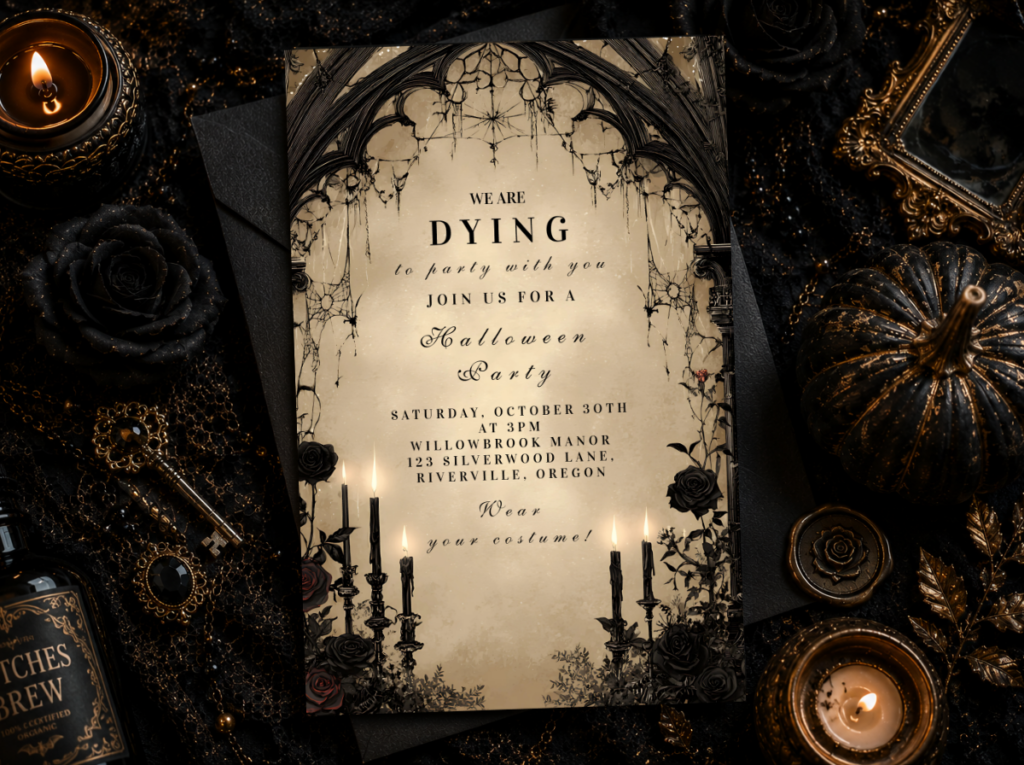
The All Halloween stationery collection — game cards, scavenger hunt prints, and party invitations for children’s Halloween parties.
Section 02 Halloween Games for Adults
The best adult Halloween party games share a different set of qualities from children’s games: they reward knowledge, creativity, or social intelligence rather than speed or physical participation; they have a natural humour level built in rather than requiring the host to generate it; and they have a clear time limit that ends before the game overstays its welcome. Adult Halloween party games that fail almost always do so for the same reason: they ran twenty minutes longer than their novelty sustained.
🧠
Halloween Trivia
6–40 players · Adults · Prep: 20–30 minutes · Duration: 20–30 minutes
Teams of three to five players compete to answer Halloween-themed trivia questions across four to five categories: horror film history, Halloween folklore and traditions, spooky general knowledge, pop culture Halloween moments, and one ‘wild card’ category specific to the guest group. Questions printed on cards or displayed on a screen; one host reads, teams write answers, reveal and score per round. The team-format prevents individual knowledge gaps from eliminating players who know less about horror film history, and creates table-level conversation between rounds. Prepare twenty to twenty-five questions — enough for five rounds of four to five questions each — and add a tiebreaker question in a sealed envelope in case of a draw. A small prize per winning team member; the prize communicates that the game is worth winning rather than just worth playing.
🎭
Costume Contest with Real Judging Criteria
Any number · Adults · Prep: 0 minutes · Duration: 15 minutes
A costume contest at an adult party almost always produces better engagement when judging categories are announced in advance (on the invitation or at the start of the party) rather than left as a vague ‘best costume’ call. Suggested categories: Most Creative, Best Group Costume, Best Use of Existing Wardrobe, Most Committed to Character, Audience Favourite by applause vote. Each category has one winner; the host announces results in reverse order of prestige, with Audience Favourite last. The specific categories give guests who are not confident in elaborate costume construction a route to winning ‘Best Use of Existing Wardrobe’ that reads as equally valued rather than as a consolation prize. One prize per category; small and food-related (a bottle of something, a box of chocolates) rather than an elaborate object that is difficult to carry.
✏️
Two Truths and a Halloween Lie
6–20 players · Adults · Prep: 0 minutes · Duration: 15–20 minutes
Each player writes three Halloween-adjacent statements about themselves — two true, one invented — on a card. Statements in the Halloween register: ‘I have visited a real haunted location,’ ‘I once spent Halloween in a different country,’ ‘I am genuinely afraid of spiders.’ Cards collected, shuffled, and read aloud by the host one at a time; the group votes on which statement they believe is the lie. Players score one point for each lie they identify correctly; the player whose lie fools the most people scores two points. The game works in any group size from six to twenty and requires no preparation from the host beyond distributing cards and pens at the start. It reliably surfaces surprising information about guests who know each other well, which is the social function adult party games perform best.
🍴
Halloween Category Game — Adult Forfeit Version
6–16 players · Adults · Prep: 0 minutes · Duration: 10–15 minutes
Players sit in a circle. The host names a Halloween category (‘things found in a haunted house,’ ‘famous fictional monsters,’ ‘Halloween candy brands’). Players go around the circle naming one item in the category per turn. Anyone who repeats an item or cannot name one within five seconds sits out that round. Last player remaining wins the round. Simple forfeit for players who sit out: answer a personal trivia question from the host, or perform a brief party challenge (tell a one-sentence ghost story on the spot). No alcohol requirement; the forfeit is social rather than physical. Play three to five rounds with different categories; the full game runs comfortably in fifteen minutes.
🎮 Game Tip
Give every adult game a 10–15 minute cap and enforce it — the games that disappoint are the ones that drag past their novelty rather than the ones that end cleanly while the energy is still high. If a game is running well at the 12-minute mark and guests are engaged, it can extend by one round. If it is running well at the 20-minute mark, it has already run too long. Announce the time limit at the start of each game so guests know when to expect the resolution.
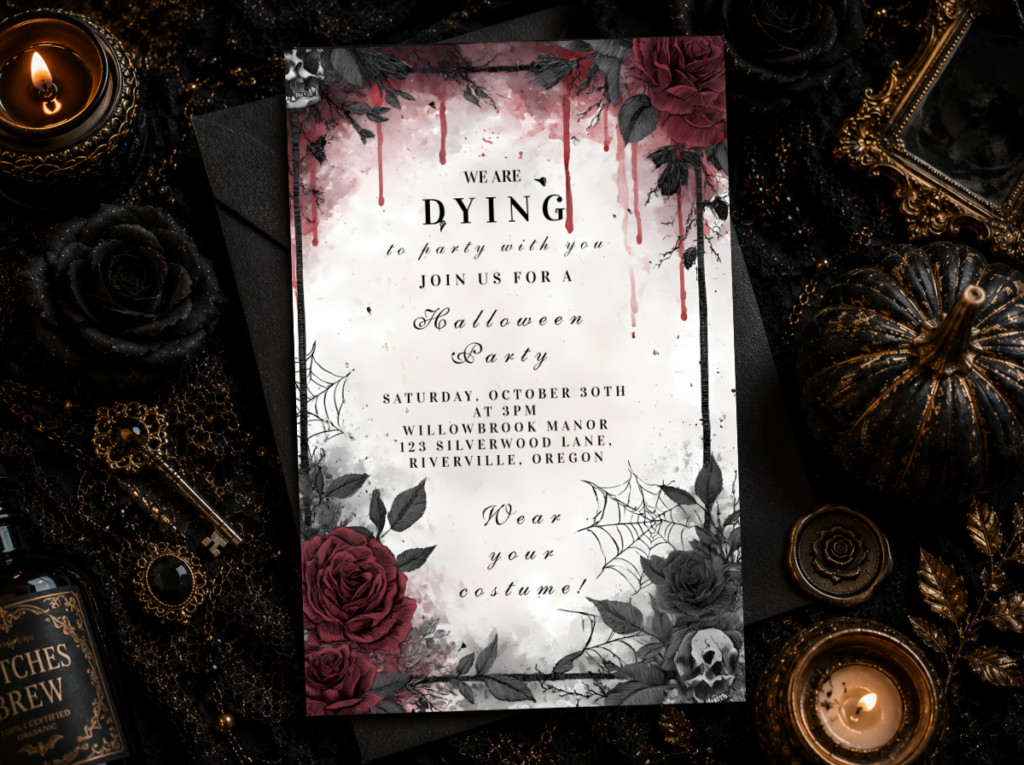
The All Halloween stationery collection — trivia card prints, costume contest ballots, and party invitations for adult Halloween parties.
Section 03 Halloween Games for Teens, School & Classroom Parties
Teens and school-age groups (roughly ten to seventeen years old) occupy the most specific design challenge of the three audiences: they are too old for children’s prize games and often too self-conscious to engage with the physical games that younger children embrace, but they are not in the social environment where adult-format games make the most sense. The games that work best for teens are ones that produce laughter through group creative output rather than through individual performance, and ones that can be played in a classroom or large group format without specialist materials.
🖊️
Pass the Story
8–40 players · Ages 10–17 · Prep: 0 minutes · Duration: 15–20 minutes
Each player writes the opening line of a Halloween ghost story on the top of a sheet of paper. At a signal, players pass their paper one position to the left and add a second line to the story they receive — without reading the previous writer’s contribution, which is folded down before passing. This continues for six to eight rounds of writing and folding. At the end, papers are unfolded and the complete stories — assembled from eight separate contributions, none of which the contributors could see — are read aloud to the group. The results are almost always genuinely funny and frequently bizarre; no skill is required, and the collective output is the entertainment rather than any individual’s performance. Works in any group size from eight to an entire classroom, requires only paper and pens, and produces a physical take-home object for each participant.
🃏
Halloween Taboo — Halloween Words Edition
8–30 players · Ages 10–17 · Prep: 10 minutes · Duration: 20–25 minutes
Prepare a set of cards in advance (or write them on index cards at the event), each with one Halloween-related word to be described and four forbidden words that cannot be used in the description. Example: word is ‘vampire’; forbidden words are blood, bite, coffin, cape. Teams of equal size; one player per turn describes the target word to their team using only legal words for sixty seconds; team scores a point for each correct guess. The forbidden-word constraint forces creative description and produces the specific frustrated-but-laughing energy that group word games generate best. This format works for teens because it rewards verbal skill and lateral thinking over speed or physical participation, and because the competitive team format removes individual self-consciousness.
🎭
Halloween Pictionary — Group Format
8–40 players · Ages 10–17 · Prep: 10 minutes · Duration: 15–20 minutes
A standard draw-and-guess format with Halloween-specific word cards. One player draws while their team guesses; sixty seconds per turn; one point per correct guess within the time limit. The Halloween word list for teens should go beyond basic icons (ghost, pumpkin, witch) into categories that require more creative interpretation: ‘haunted hospital,’ ‘zombie apocalypse,’ ‘full moon,’ ‘witches’ cauldron.’ The drawing-format game works in a classroom because it requires only a whiteboard or flip-chart paper and markers, produces public entertainment for the whole group simultaneously, and runs without any quiet or individual-performance moment that self-conscious participants might find uncomfortable. For very large groups, run two simultaneous games on opposite sides of the room with a final round between the two group winners.
🔍
Halloween Murder Mystery — Simplified Format
8–20 players · Ages 12–17 · Prep: 30 minutes · Duration: 45–60 minutes
A simplified one-page murder mystery format: each player receives a character card with their character name, one secret (a piece of information relevant to the mystery), and one alibi (where they were at the time of the fictional Halloween-themed crime). The host reads a brief scenario, then players mingle for twenty minutes questioning each other in character to gather information. At the end, each player votes for who they believe is the murderer — the player designated as the murderer tries to avoid detection. The player whose identity is correctly identified by the most voters is revealed. This format requires thirty minutes of host preparation to produce the character cards but zero additional materials; it works for any group of eight to twenty teens and produces the most sustained group engagement of all the teen-format games listed here.
🎮 Game Tip
For classroom and school Halloween party formats, choose games where the entertainment is produced by the group output rather than by individual performance — Pass the Story and the draw-and-guess format produce laughter that belongs to the group rather than to one person, which is the social dynamic that works best in a classroom context where some participants are self-conscious and where the host has limited ability to manage individual discomfort. The goal is for every participant to feel included in the entertainment rather than exposed by it.
Frequently Asked Questions
What games work for a mixed-age Halloween party?
Three games from across the sections above work reliably for mixed ages. The candy scavenger hunt can be calibrated for different age groups by adjusting the difficulty of hiding positions — visible for young children, concealed for teens, with a separate zone per age group and a combined prize reveal at the end. Ghost freeze dance works for children and adults simultaneously because adults playing freeze dance with children produces its own comedy, which is entertainment for the adult guests. The costume contest with specific judging categories works across ages because children compete in age-specific categories while adults compete in their own — and the announcement format keeps the full mixed-age group engaged during the judging. For mixed-age parties: run one all-ages game, one children-only game, and one adult-or-teen game sequentially rather than simultaneously, so that the full guest list feels included at some point during the game schedule.
How many games does a two-hour Halloween party actually need?
A two-hour party needs two to three games, not more. One opening game that runs fifteen to twenty minutes and gets guests interacting immediately; one main-event game that runs twenty to thirty minutes and represents the most memorable activity of the evening; and one optional closing game of ten to fifteen minutes if the energy sustains it. More than three games at a two-hour party means either the games are running too short (and guests are not fully engaged with each) or the party is spending most of its time on game administration rather than on the social interaction that games exist to facilitate. Quality of individual game selection matters more than quantity: one genuinely well-run game that produces group energy is a better investment than three mediocre games run back-to-back.
What’s a good no-prep Halloween party game for a time-pressured host?
Two Truths and a Halloween Lie (adult version) and Ghost Freeze Dance (children’s version) both require zero advance preparation — only a music source for the freeze dance and paper and pens for Two Truths. The Halloween Category Game requires nothing at all beyond the host knowing how to explain it. The Pass the Story game for teens requires only paper and pens available at the venue. Any of these four work as emergency fall-backs for a host who has run out of preparation time; all four produce genuine group engagement; and none requires a timer, scorekeeping materials, or printed cards that might not be available. The no-prep game that works best at each audience: Freeze Dance for children, Two Truths and a Halloween Lie for adults, and Pass the Story for teens.
Kids · Adults · Teens · 10–15 Minute Cap
Shop Halloween Party Stationery
Invitations, game cards, scavenger hunt prints, and costume contest ballots — the printed layer that completes every Halloween party game setup.