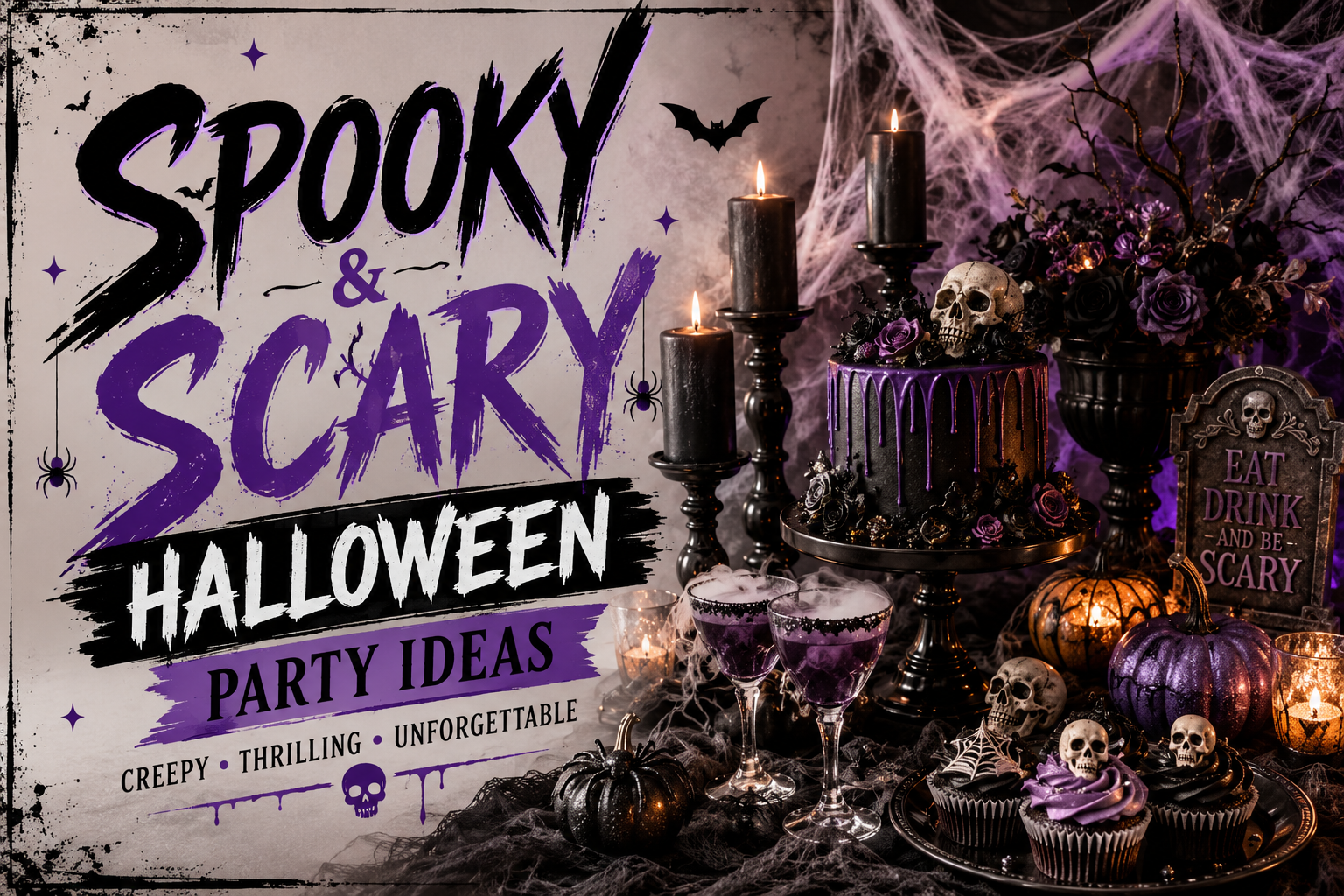
Spooky & Scary Halloween Party Ideas
Halloween Party Ideas · Spooky & Scary
Spooky & Scary Halloween Party Ideas
The three atmosphere-first principles, the complete decor and table guide, costume direction, and the stationery that sets the tone before anyone arrives.
Most Halloween parties are decorated for Halloween. A genuinely spooky Halloween party is designed for atmosphere — and the distinction between those two things is the entire difference between a room that feels like autumn and a room that makes guests genuinely uneasy in the specific way that good Halloween is supposed to. Decorating for Halloween is an additive process: you add orange, add props, add a fog machine. Designing for atmosphere is a subtractive one: you start with darkness, add one strong element, and resist everything else. The spooky Halloween party is almost always the one with fewer decorations than the host planned.
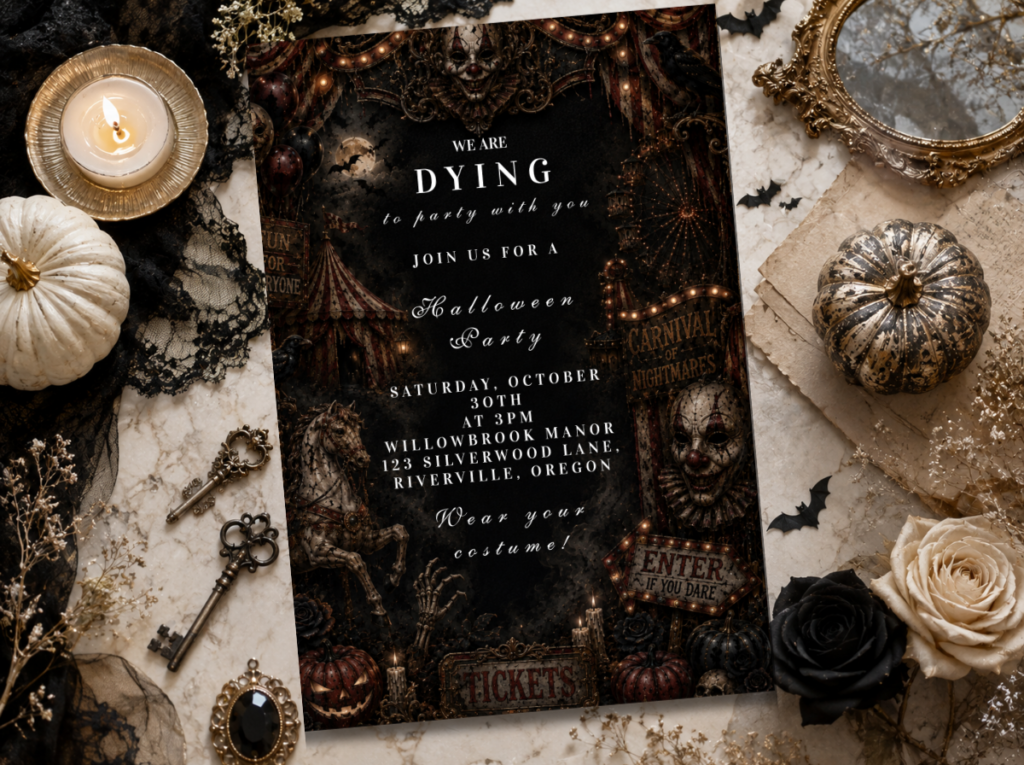
Shop the Spooky & Scary Halloween collection.
Invitations, banners, and table signs in the dark atmospheric palette.
“The party that actually feels like Halloween — not a costume party with orange napkins. The difference is always darkness, restraint, and the one element that makes guests stop when they walk into the room.”
Section 01 What Makes Spooky & Scary Distinct — Atmosphere Over Decoration
The spooky and scary Halloween direction is the atmosphere-first direction — the only Halloween approach where the quality of the sensory experience the room produces is more important than the quantity of decoration elements it contains. Three principles separate a genuinely atmospheric Halloween space from a room that is simply decorated for Halloween.
Principle 1
Darkness as a Design Choice, Not an Afterthought
What fails: Orange-and-black in equal measure. The orange-and-black palette is the commercial Halloween palette — it communicates the season without communicating any specific atmosphere. A room that is equally lit in orange and dark reads as cheerful Halloween rather than as spooky Halloween, because the orange carries warmth and energy that counteracts the dark.
What works: Deep charcoal and near-black as the dominant base, with a single warm accent — deep orange or blood-red, never both simultaneously. The dark base is established first by dimming the primary room lighting as far as the venue allows; the warm accent is introduced through candles, a single lit pumpkin, or one warm amber lamp in a specific position. The darkness is the atmosphere; the warm accent point is what guests look toward. A predominantly dark room with one visible warm light source reads as specifically spooky in a way that an orange-and-black room never can.
Principle 2
Texture Over Colour — Fog, Cobwebs, and Uneven Light Do More Than Any Prop
What fails: Ten individually placed Halloween props in full room lighting. Props in a bright room read as decoration; they read as designed objects placed at intervals, which is the opposite of the unsettling quality that atmospheric Halloween requires. Even the most carefully chosen prop loses its atmospheric power when it is fully visible from every angle under even illumination.
What works: One or two texture elements that change the quality of the room itself rather than adding objects to it. A fog machine at floor level in a darker corner, so that guests’ feet are obscured as they move through the space. Stretched cotton cobweb material draped over the entrance doorframe and across the ceiling of one room corner, catching and diffusing any light that reaches it. Uneven candlelight — candles placed at floor level, at table level, and at shelf level rather than all at one height — so that the shadows in the room move when any guest or candle flame moves. These texture elements cost the same or less than a collection of props and produce atmospheric impact that no prop collection can replicate.
Principle 3
Restraint — One Strong Element Beats Ten Small Scattered Ones
What fails: Covering every available surface with Halloween props at roughly equal size and prominence. This approach produces a room that looks ‘very Halloween’ in the specific way that a party supply store looks ‘very Halloween’ — which is to say, busy and commercial rather than atmospheric and unsettling. The more props in a room, the more the room reads as assembled rather than designed.
What works: One dramatic focal element per room zone — the room has one thing that makes guests stop when they walk in. A single large dramatic spiderweb suspended from the ceiling with one carefully positioned light source behind it. A single full-height silhouette prop (a cloaked figure, a bare branch installation reaching the ceiling) against a dimly lit backdrop wall. One fog machine in the corner of one room, not distributed across three rooms at medium intensity. The restraint is the design decision; it forces the one strong element to do all the atmospheric work rather than sharing it with nine other elements at diminished intensity.
🕸 Styling Tip
Atmosphere comes from lighting and texture, not from how many decorations are in the room. One dim corner with low fog and a single lit pumpkin reads scarier than a fully-lit room packed with props. Before adding any decoration, dim the primary room lighting as far as it will go. What reads as atmospheric in that light is worth placing; what reads as decoration in that light belongs to a different Halloween direction.
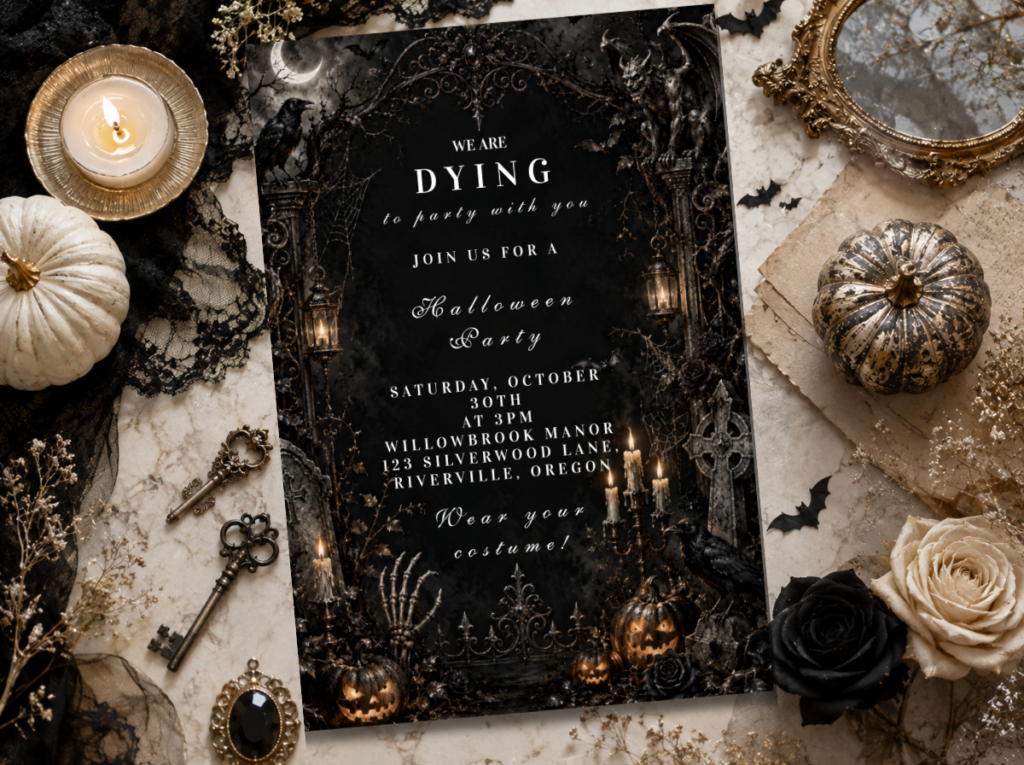
The Spooky & Scary Halloween collection carries invitations and table stationery in the dark atmospheric palette.
Section 02 Decor & Table — The Atmosphere-First Approach
Every decor decision follows the same restraint principle: one strong element per zone, darkness as the base, texture before colour.
Cobweb-draped entryway — the first atmospheric moment
The entrance is the most important atmospheric decision in the entire party — because it is the first sensory experience guests have of the space, and the first impression determines whether the rest of the evening reads as atmospheric or simply as decorated. Stretch cotton cobweb material across the full width of the entrance doorframe, from corner to corner and slightly drooping at the centre. Extend individual strands downward so that guests must move through the cobweb material rather than around it — the tactile quality of walking through cobweb material is more atmospherically effective than any visual element. Add one light source directly behind or above the cobweb arrangement so that it becomes visible as a silhouette rather than as a material object. No additional props at the entrance — the cobweb doorway is the atmospheric statement and nothing beside it should compete with it.
Dim, uneven candlelight — the primary decoration and the primary lighting
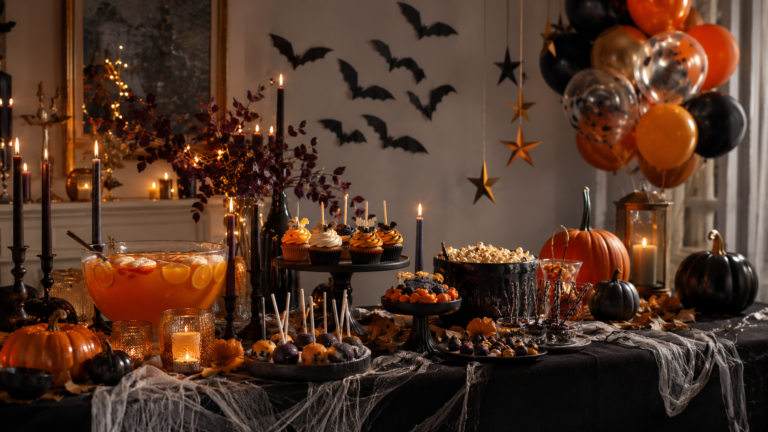
Candles placed at three levels simultaneously: floor level (inside glass votives or hurricane glasses at the base of walls, the base of furniture, and along skirting boards); table level (taper candles in slim holders at the dining or food table, and votives clustered at the centre of any surface where guests gather); and elevated level (a single candle in a taller holder at one position per room, slightly above eye level when seated). This three-level candlelight arrangement produces moving shadows at multiple heights simultaneously — which is the specific atmospheric quality that a single-level arrangement cannot achieve. Use dark or unbleached beeswax candles rather than bright white paraffin, which produces a cooler and less atmospheric light quality. The candle flames moving in response to guests moving through the room is itself an atmospheric element — it makes the room feel alive in a way that no static decoration can.
Charcoal and black table — one orange or red accent, not both
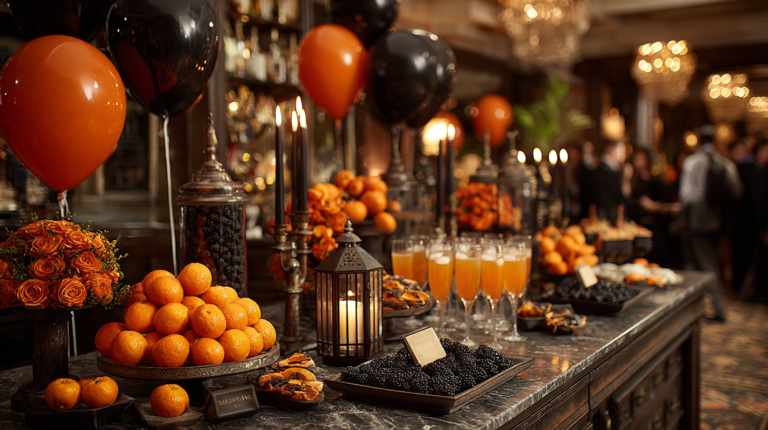
A deep charcoal or black linen tablecloth as the table surface — the dark ground is what makes any warm accent element glow rather than simply sitting on the table. A single deep orange or deep blood-red accent: either a dark orange linen runner down the centre (not bright orange, which reads as commercial Halloween; deep burnt orange, which reads as atmospheric) or a line of deep red votives as the sole colour accent. Not both the runner and the coloured votives — two competing accent colours read as generic Halloween party supply rather than as a designed atmospheric table. Dark ceramic or black serving ware on the food table. Menu cards and table signs in the dark atmospheric palette, not in white or cream, which would introduce light into a surface zone intended to stay dark.
Silhouette props against a lit backdrop — the most effective spooky visual
A silhouette is more atmospherically effective than a three-dimensional prop because the imagination fills in what the silhouette does not show. A bare branch arrangement — several dark branches gathered and placed upright in a weighted dark vessel — positioned in front of a dimly lit wall with a single light source behind it produces a shadow that is larger than the arrangement and reaches the ceiling. The shadow is the decoration; the branches are the mechanism that produces it. A cloaked or draped form (a dark fabric draped over a floor lamp or a tall stand) positioned in a corner with a single candle at its base produces a silhouette that reads as a figure rather than as a decoration object. These two silhouette elements in a single room require no additional props and produce an atmospheric quality that a room full of explicitly Halloween-themed objects rarely achieves.
🕸 Styling Tip
Keep colour to black, charcoal, and one accent — either deep orange or blood-red, never both. Two competing accent colours in the same room read as generic Halloween party supply rather than as atmospheric. The single accent colour is what guests’ eyes move toward in the dark room — it should be the most carefully chosen element, not an afterthought.
Browse the full Spooky & Scary Halloween collection for invitations, banners, and table signs in the dark atmospheric palette.
Section 03 Costumes & Invitations
The costume direction for a spooky and scary Halloween party follows the same restraint principle as the decor: one strong concept, executed with commitment, reads as atmospheric. A complex costume assembled from many individual elements reads as assembled. The costumes that produce the most genuinely unsettling impression at an atmospheric Halloween party are those with a strong silhouette that reads from across the room — a long cloaked form, a tall figure in solid dark material, a classic white-sheet ghost that commits completely to its simplicity — rather than those that require close inspection to appreciate their detail.
The strong silhouette direction — read from across the room
A full-length dark cloak with a hood worn forward — the classic ominous figure that reads as specifically unsettling at distance because the face is partially obscured. A Victorian mourning dress in dark material with a veil — the specific combination of formality and concealment that reads as uncanny rather than as costumed. A long white dress with minimal additional detail — the restraint of a completely simple costume in white against a dark room creates an atmospheric impression that a complex costume rarely achieves. In each case the silhouette is the costume; it reads from across the room before the detail is visible.
The classic Halloween direction — committed simplicity
A witch in entirely black with a well-chosen hat — not a costume-supply witch, but a considered one: the hat has a specific shape and the black has a specific quality of fabric that reads as designed rather than as purchased. A classic ghost costume (white sheet, two eye holes) worn with complete commitment rather than as an ironic reference — the simplicity of the ghost silhouette in a dark atmospheric room produces an impression that is more genuinely eerie than most complex costumes at a spooky party. A skeleton in all-black with white bone detail — the bone detail visible only at close range, so that the primary impression at distance is a dark figure. In all three cases the commitment to the concept rather than the elaboration of it is what produces the atmospheric quality.
The invitation for a spooky and scary Halloween party should carry the same atmosphere-first approach as the decoration: dark background, minimal colour, one strong graphic element — a cobweb silhouette, a bare branch, a single candle flame — in the deep charcoal and dark tone palette. The invitation is the first atmospheric signal the guest receives, and it should read as specifically spooky rather than as generically Halloween. A dark invitation on deep charcoal or near-black card stock communicates the party’s register from the moment the envelope is opened.
Browse both collections for spooky Halloween invitations and All Halloween stationery options.
Frequently Asked Questions
How do I make a Halloween party actually feel scary rather than just decorated?
Three decisions in order, and in this order: dim the primary room lighting before placing any decoration (the darkness is the atmosphere; everything else is added to it); add one texture element that changes the quality of the room itself rather than adding an object to it (fog at floor level, cobweb material at the entrance, uneven candlelight at three heights); then choose one strong focal prop per room zone and remove everything else you were planning to add. The restraint is the most difficult decision and the most important one. A room with two genuinely atmospheric elements in genuine darkness reads as scary. The same room with those two elements plus twelve additional props at medium lighting reads as a decorated party. The decoration is what prevents the atmosphere from forming.
Is this theme appropriate for children?
The spooky and scary direction is an adult and teen-plus party concept. The atmosphere-first approach — deep darkness, uneven lighting, fog effects, strong silhouettes against lit backdrops — is specifically designed to produce unease, which is not an appropriate guest experience for young children. For a family-friendly Halloween party with younger guests, the vintage Halloween, coffee brewing, or Little Boo ghost directions are more appropriate — all of them produce warm, festive, and whimsical atmospheres without any of the specifically unsettling qualities of the spooky and scary direction. Organise the spooky party for teen and adult guests; choose a different direction if children under twelve will be present.
How do I keep a scary Halloween party tasteful rather than gory?
The distinction between atmospheric spooky and gory Halloween is the same as the distinction between what is implied and what is shown. Atmospheric spooky works through suggestion — the silhouette that the imagination completes, the corner that is too dark to see into fully, the cobweb material that brushes a guest’s face without them seeing it coming. Gory decoration works through explicit visual representation, which produces a different and much less refined experience. The restraint principle applies here too: the decoration that does not show everything is always more unsettling than the decoration that does. Eliminate any prop or element that depicts explicit physical harm; anything that reads as horror-movie rather than as Halloween atmosphere. The spooky direction is for elegantly unnerving, not for disturbing.
Atmosphere First
Spooky Halloween Party Stationery
Invitations and table stationery in the dark atmospheric palette — the printed element that sets the atmosphere before any guest arrives.