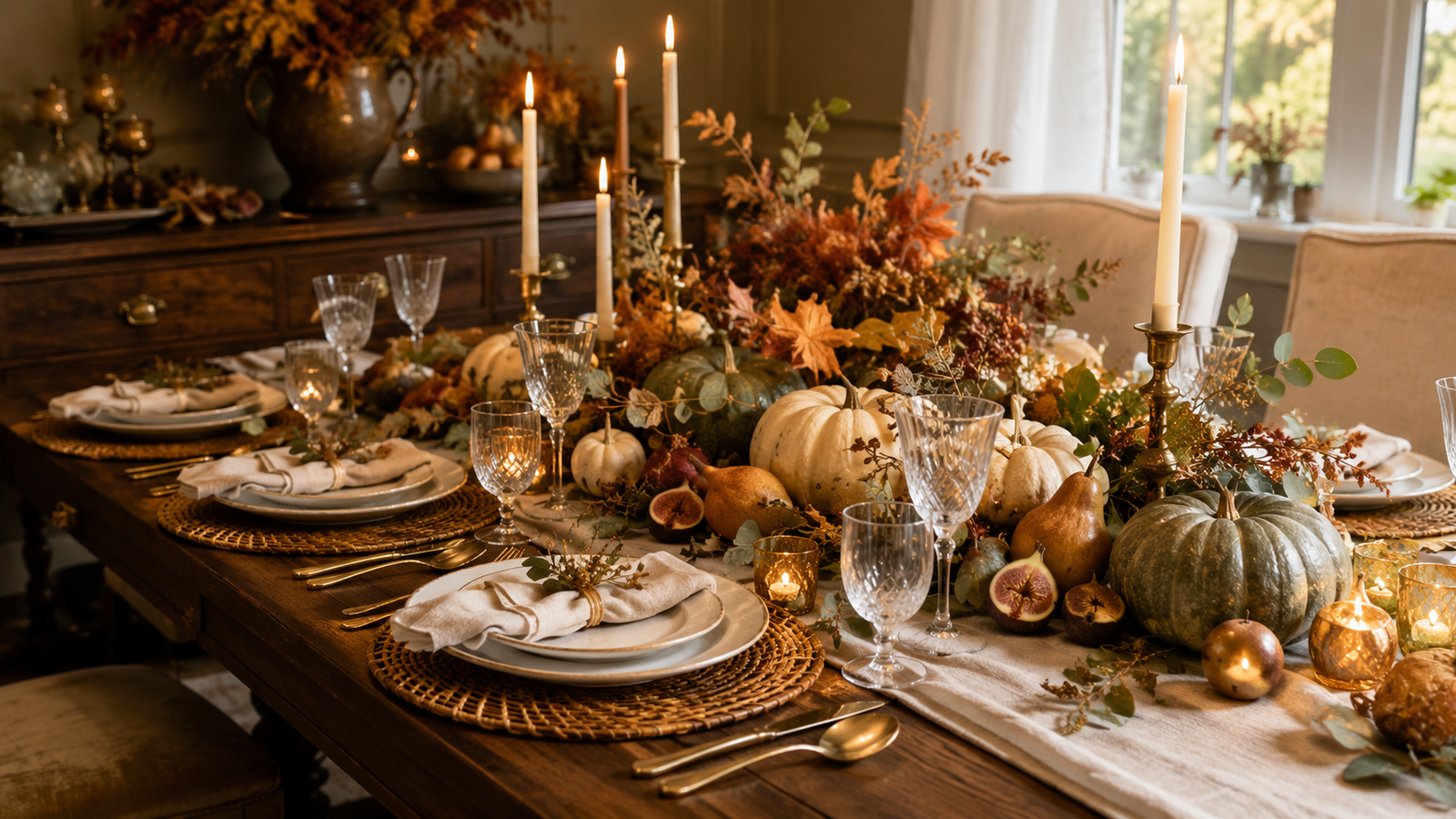
Thanksgiving Table Setting Ideas
Thanksgiving · Per-Seat Setting Guide
Thanksgiving Table Setting Ideas
Per-seat guidance for a finished Thanksgiving place setting — the layering order, the personal touch that makes each seat look considered, and a practical formula that scales to a large group.
The Thanksgiving table setting is a per-seat question, not a whole-table question — and that distinction matters. The centerpiece and the runner are about the table’s overall composition; the place setting is about the individual experience of the guest who sits at that specific seat. A beautifully set table where each individual seat feels unfinished — no place card, no napkin detail, no personal element — reads as a decorated table rather than a hosted table. The per-seat moment is what turns a dressed table into a gathering.
This guide is focused on the individual seat: what to layer, what personal element to add, and how to execute a finished setting efficiently at scale.
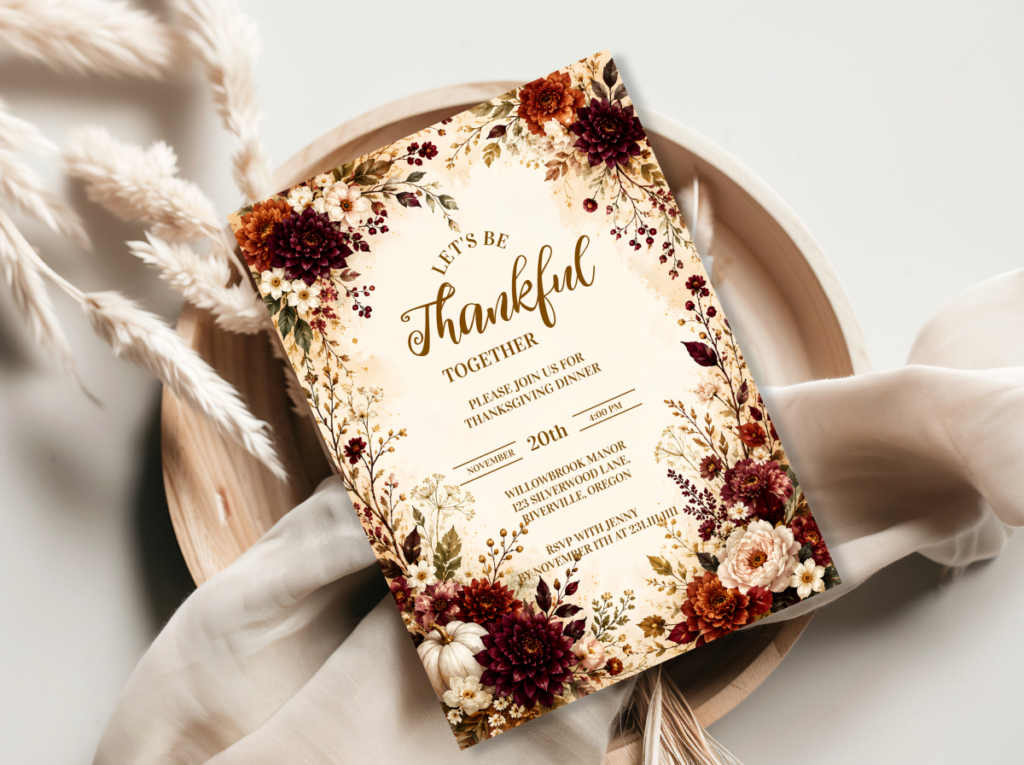
Browse the Elegant Floral Thanksgiving Dinner collection at Lush Party Boutique — warm floral place cards and table stationery designed to complete every individual seat.
“The place setting is the first thing a guest touches, before they’ve said a word — and it tells them, in under two seconds, whether they were expected or simply accommodated.”
Section 01 The Anatomy of a Thanksgiving Place Setting
A finished individual Thanksgiving place setting is built from three layers. Each layer can be as simple or as considered as the host chooses — but skipping any one of the three produces a seat that reads as unfinished regardless of how much effort went into the other two.
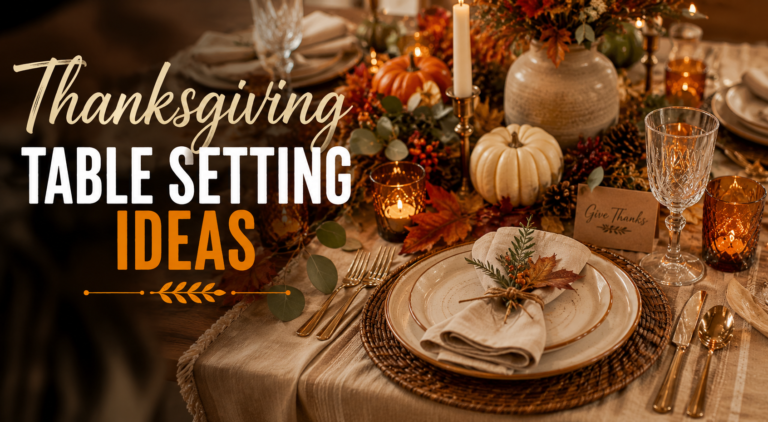
Layered plates. A charger plate beneath the dinner plate adds visible depth and a sense of structure to the individual setting — even when the dinner plate itself is a simple everyday piece. The charger’s function is to frame the plate rather than to be seen when food is served: it stays on the table through the starter course and is removed before the main. In terms of aesthetic impact, a charger in a warm metallic or natural material — burnished gold, aged copper, woven rattan, dark-glazed ceramic — elevates a simple white dinner plate into a layered setting that reads as considered. The combination of charger and dinner plate also communicates the meal’s formality level before a course arrives: a rattan charger beside a cream stoneware plate reads as warm and gathered; a burnished-gold charger beside a white bone china plate reads as dressed-up occasion.
A name element. A place card at each seat does two jobs simultaneously: it tells each guest where they belong at the table, which removes a moment of social friction as guests find their seats, and it communicates that the host considered each guest’s position deliberately — who should sit beside whom, who faces the room and who faces the window. The place card is the most personal printed element of the Thanksgiving table and the one most likely to be picked up, read, and kept. It should be in the table’s typeface and palette — a warm serif or a distinctive design from the Lush Party Boutique stationery suite — and placed consistently at every seat: at the top of the dinner plate, tucked into the napkin fold, or propped beside the glass.
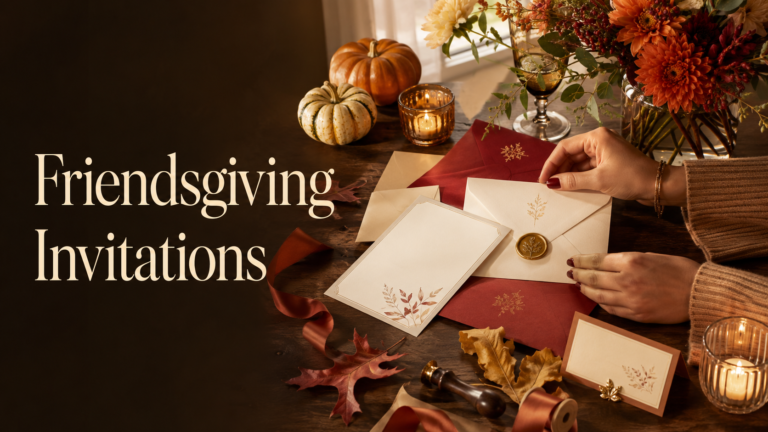
A small personal touch. A single small element per seat — beyond the charger, plate, napkin, and place card — is what transforms each seat from a correctly set place into a finished and personal moment. A sprig of rosemary or a small dried botanical tucked into the napkin fold. A wax-sealed envelope beside the place card. A small seasonal favour at the setting’s upper corner. A single bloom from the centrepiece arrangement laid across the folded napkin. The specific element matters less than its presence: one additional personal detail per seat consistently produces the ‘this was set for me specifically’ reading that is the defining quality of a hosted Thanksgiving table.
🍴 Setting Tip
Add one small personal element per seat — a place card, a sprig tucked into the napkin fold, a wax-sealed card — even if the rest of the setting is simple. That one touch is what makes each seat look finished rather than just set. The element does not need to be elaborate; it needs to be consistent across every seat so that every guest receives the same signal.
The Elegant Floral Thanksgiving Dinner collection at Lush Party Boutique — place cards and table stationery designed as part of the per-seat finishing layer.
Section 02 A More Editorial Place Setting Direction
For hosts who want a Thanksgiving place setting that reads as specifically designed rather than traditionally seasonal, the Art Nouveau Thanksgiving Dinner direction offers a place setting vocabulary that is distinctive without being theatrical.
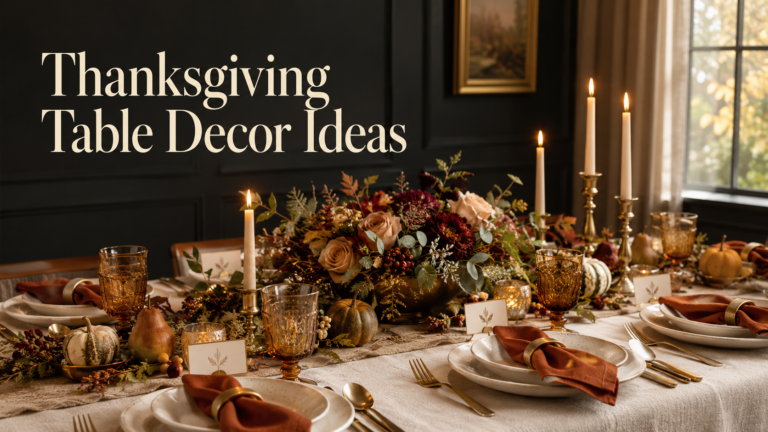
The Art Nouveau place card as the setting’s personality. In the Art Nouveau direction, the place card carries more visual weight than in a conventional setting — because its organic linework and muted jewel-tone palette are distinctive enough to signal the table’s aesthetic direction on their own, without the support of an elaborate charger or a complex napkin fold. A simple white or cream dinner plate with a linen napkin in a deep sage or muted plum, a place card in the Art Nouveau stationery design from Lush Party Boutique, and a single dried botanical stem beside the card: these three elements together produce a place setting with more personality than a matched traditional setting with significantly more components.
Muted jewel tones in the napkin and glassware. The Art Nouveau direction’s palette — deep forest green, muted plum, aged burgundy, and burnished amber — is most naturally carried into the place setting through the napkin colour and the glassware choice. A napkin in deep sage or muted plum, folded simply and placed on the dinner plate rather than arranged in a decorative fold, communicates the palette immediately without requiring any additional decorative element. Where coloured glassware is available in a warm jewel tone, a single water or wine glass in muted amber or dark green provides the palette repetition at the setting’s upper register — tying the napkin level to the glass level in the same visual logic.
🍴 Setting Tip
Let the place card carry the personality when the rest of the setting is simple — a distinctive place card design can do the work of an elaborate setting on its own. The Art Nouveau design’s organic linework and muted jewel-tone palette are strong enough that the plate, napkin, and glassware can remain entirely simple and the setting will still read as intentional and considered.
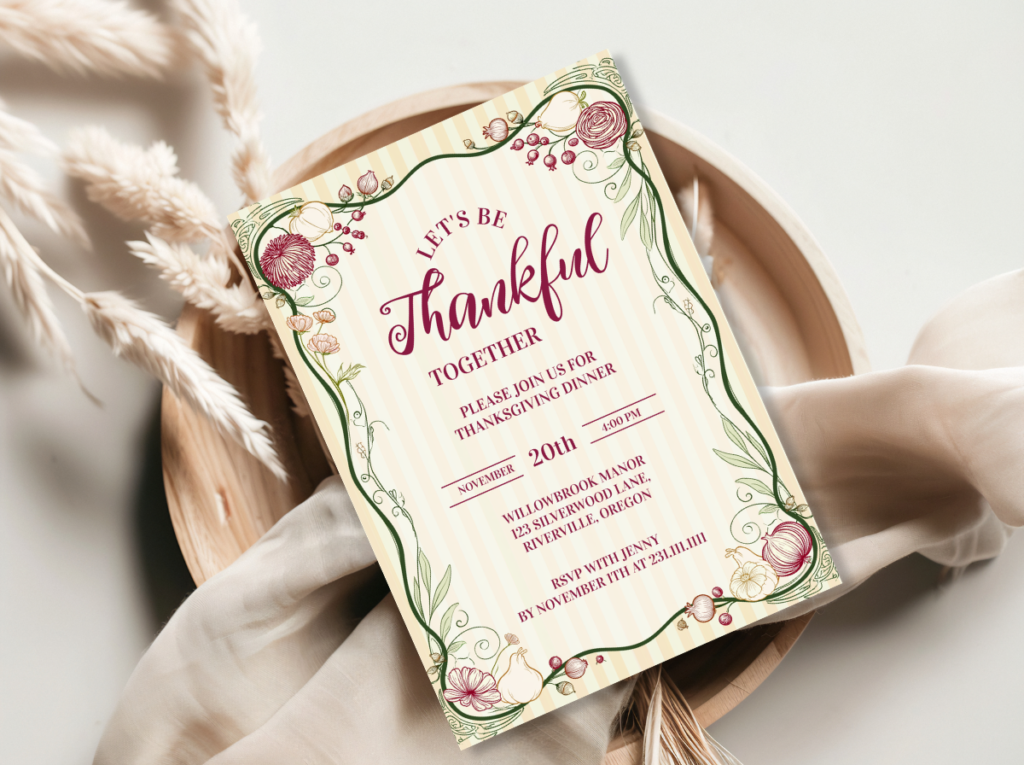
The Art Nouveau Thanksgiving Dinner collection at Lush Party Boutique — flowing linework place cards in muted jewel tones for the most editorial Thanksgiving setting direction.
Section 03 Setting a Table for a Large Group Without It Taking All Day
A Thanksgiving table for ten or more guests is a different operational challenge from a table for six — and the place setting formula needs to scale efficiently without losing the per-seat personal quality that makes each setting feel finished.
Establish the formula before you begin. Decide the exact sequence of every element at each seat before placing the first one: charger position, dinner plate, napkin fold and position, cutlery placement, glassware position, place card position, and personal touch. Work from one end of the table to the other, placing one layer across all seats before moving to the next — all chargers first, then all dinner plates, then all napkins, and so on — rather than completing one full seat before moving to the next. Assembly-line setting is faster and produces more consistent spacing and positioning across all seats simultaneously.
Pre-fold napkins the day before. The napkin fold is the most time-consuming individual seat element and the one most easily prepared in advance. A simple fold — a half-fold to a rectangle, then a third-fold to a neat square, then placed flat on the dinner plate — takes under thirty seconds per napkin and can be done the day before and stored flat, then placed on the day without re-ironing. A more complex fold should be reserved for tables of six or fewer; for larger gatherings, the simpler the fold the more consistent the result across the full table length.
Printed place cards, placed last. Printed place cards from a stationery suite — rather than handwritten cards — ensure consistency of appearance across the full table and reduce the time spent on individual card production. They should be placed as the final step — after all plates, napkins, and glassware are in position — because they mark the completion of each seat and provide a final visual check of the full table’s appearance before guests arrive. At Lush Party Boutique, the Elegant Floral Thanksgiving place card suite is designed to work as this completing layer: placed at the top of the dinner plate or tucked into the napkin at every seat, it turns a well-set table into a hosted one.
The Elegant Floral Thanksgiving Dinner collection at Lush Party Boutique — place cards that scale to any table size and complete every individual seat.
Frequently Asked Questions
Do I need a charger plate for every seat?
A charger at every seat is not required, but its absence is noticeable in a way that most other missing setting elements are not. The charger does three things simultaneously: it frames the dinner plate and gives the individual setting visual depth; it adds a layer of warmth and material texture to the setting’s base; and it covers the tablecloth between the table surface and the dinner plate’s edge in a way that makes the setting read as more intentional even when the dinner plate itself is simple. If chargers are not available for the full table, the practical alternative is a placemat in a warm natural material — woven rattan, natural linen, or a leather-effect mat in a warm neutral — which performs the same framing function at a lower cost and with similar visual impact.
How do I fold a napkin for a Thanksgiving table without special tools?
Three folds work at any skill level and look finished consistently. The simplest: fold the napkin in half to form a rectangle, then fold again to form a square, and place it flat on the dinner plate with the open corner facing the guest — clean, minimal, and appropriate for any aesthetic direction. The second: roll the folded napkin into a loose cylinder and slip it through a napkin ring, then place it at the left of the plate — the napkin ring does the decorative work and requires no folding skill. The third: fold the napkin into a loose envelope shape and tuck a small sprig or a place card into the visible edge — the tuck gives the fold a finished quality without requiring a precise fold. All three can be prepared the day before and stored flat until the day of the gathering.
What’s the fastest way to set a table for a large Thanksgiving gathering?
The assembly-line method: place one element across all seats before moving to the next, working from one end of the table to the other. All chargers first, positioned consistently at each seat. Then all dinner plates centred on the chargers. Then all napkins folded in advance and placed uniformly. Then all glassware. Then all cutlery. Then place cards as the final element at each seat. This method produces more consistent spacing and positioning than completing one full seat at a time and is typically two to three times faster for tables of eight or more. Pre-folded napkins prepared the day before, and printed place cards from the Lush Party Boutique stationery suite rather than handwritten cards, eliminate the two most time-consuming steps from the day-of assembly.
Charger · Place Card · One Personal Touch · Assembly-Line
Shop Thanksgiving Place Cards & Table Stationery
Place cards, menu cards, and per-seat stationery for elegant floral and Art Nouveau Thanksgiving table settings.