Thanksgiving Dinner Menu Ideas
Thanksgiving · Dinner Menu Guide
Thanksgiving Dinner Menu Ideas
How to build a menu that flows rather than stacks, plan oven timing before the shopping list, and present the meal to guests in a way that makes it feel designed.
The Thanksgiving menu problem is not a shortage of dishes to choose from — it is the opposite. A menu that tries to include every guest’s favourite, every traditional side, and every dish the host has been wanting to try produces a table that is abundant in quantity and overwhelming in sameness — rich, heavy, and uniform in a way that makes every component taste like the one before it. A planned Thanksgiving menu is a different document from a list of everyone’s favourites: it is an edited selection of dishes that balance each other, can be executed within the kitchen’s constraints, and still leave room for the one annual tradition that could not be left out.
The three planning principles below apply to any Thanksgiving menu at any formality level, followed by a traditional course structure and a note on presenting the menu at the table itself.
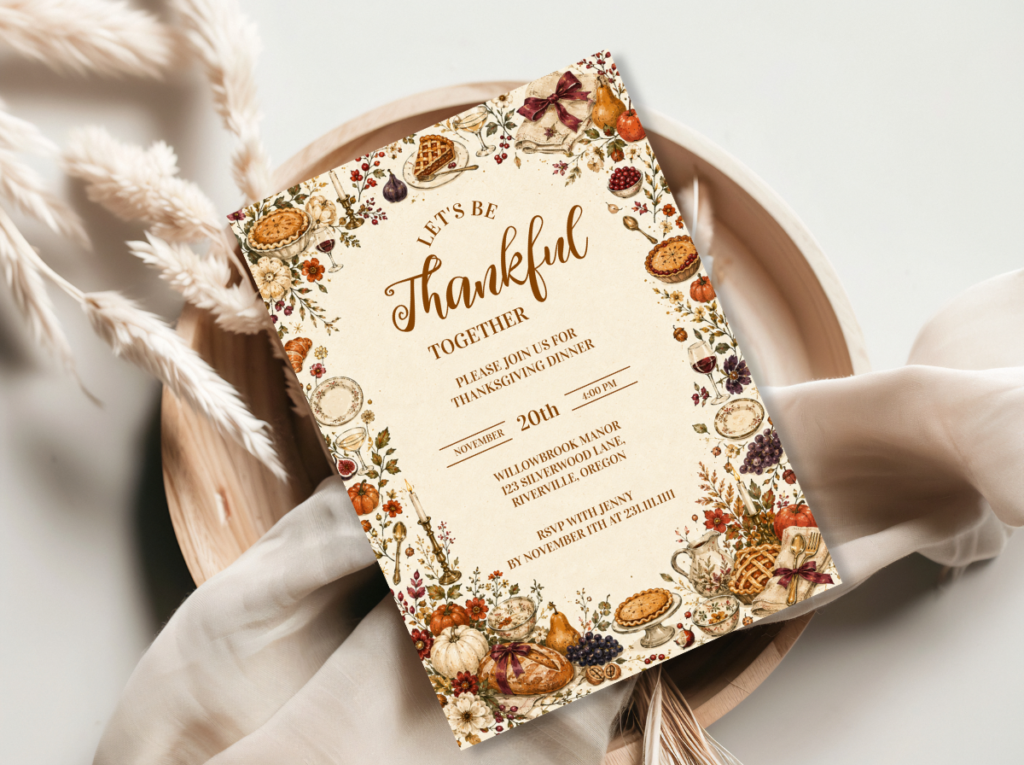
Browse the Adult Thanksgiving Party collection at Lush Party Boutique — menu cards and table stationery that present the evening’s meal as a designed sequence rather than a buffet.
“The menu is a plan, not a list of everyone’s favourite dishes stacked together. A plan has balance, timing, and an ending. A list just stops.”
Section 01 Building a Menu That Actually Flows
Three planning decisions separate a Thanksgiving menu that feels designed from one that simply accumulates dishes.
Balance rich against light. The standard Thanksgiving plate — a rich main, two or three starchy sides, and a sauce — is uniformly heavy in a way that makes every component taste like the one beside it by the third forkful. One bright, acidic element alongside the rich ones — a citrus-dressed green salad served as a starter or a small side, a lightly pickled vegetable, a cranberry preparation with enough acidity to cut through the starch — resets the palate between bites and makes every other dish on the table taste more of itself. This is not about adding a ‘healthy’ element; it is about contrast. The acidic note is what makes the rich elements taste rich rather than heavy.
Plan oven and stovetop timing before the dish list. The most common Thanksgiving cooking problem is not a failure of skill but a failure of scheduling: two dishes that both require ninety minutes at the same oven temperature, plus a third that needs a different temperature for the last forty-five minutes, plus a stovetop element that needs continuous attention during the same window. The menu should be planned with an eye to the timeline before the shopping list is written. Count how many dishes need the oven and at what temperature and for how long; count how many need stovetop attention and when; identify which dishes can be made entirely in advance and held warm or reheated. A menu that works on paper but cannot be executed within the kitchen’s physical constraints — one oven, four burners, one host — is not a Thanksgiving menu. It is an ambition.
One new dish per year, not five. The most effective Thanksgiving menu evolution is slow and deliberate: one unfamiliar dish introduced alongside the established menu each year. This preserves the 80% familiar comfort that makes Thanksgiving feel like Thanksgiving — the dishes that have appeared at every gathering anyone in the room can remember — while still providing the interest and discovery that prevents the menu from fossilising. One new dish can be fully tasted, assessed, and decided upon; five new dishes produce a table where nothing feels certain. The new dish that is welcomed becomes next year’s established dish; the one that does not work is quietly retired without disrupting the core menu.
🍴 Menu Tip
Write the oven schedule before the shopping list — count how many dishes need the oven and at what temperature and time before finalising the menu. That’s what actually determines whether the timeline works, not the dish list alone. A menu that requires the oven at four different temperatures simultaneously, or two dishes that each need ninety uninterrupted minutes that overlap with each other, will fail in execution regardless of how well each dish is made individually.
The Adult Thanksgiving Party collection at Lush Party Boutique — menu cards that communicate the meal’s planned structure to every guest.
Section 02 A Traditional Menu Structure
The traditional Thanksgiving menu follows a four-part structure that has the quality of a long-tested plan: each part has a distinct function in the meal’s arc, and the order is not arbitrary.
The starter — lighter than everything that follows. The starter’s function is to signal that the meal has begun, to give guests something to eat and drink during the transition from arrival to table, and to be light enough that it does not compete with the main or the sides for appetite. A seasonal soup served in small portions, a composed salad with enough acidity to brighten the palate before the main course’s richness, or a small shared plate of seasonal ingredients: any of these establishes the meal’s beginning without exhausting the appetite that the main course needs. The starter should be completable and cleared before the main course begins — which means it should be ready in advance and require no oven time on the day.
The main and sides — the Thanksgiving core. The main course and its accompanying sides are the meal’s centre of gravity and the portion that requires the most planning investment. The key balance across the sides is variety in preparation method — at least one roasted, one braised or slow-cooked, and one raw or lightly dressed — and variety in richness level. Three rich, starchy sides beside a rich main produces the uniformity problem described above; two rich sides plus one bright or acidic element produces a plate with contrast. The sauce or gravy bridges the main and the sides and should be planned as a design element of the plate rather than as an afterthought.
The dessert — an ending, not an addition. The Thanksgiving dessert works best when it reads as a distinct ending to the meal rather than as a continuation of it — which means it should be served after a pause rather than immediately following the main course, and preferably in a slightly different space or with a different quality of light if the table allows. A single dessert served well — at the right temperature, with the right accompaniment, after the table has been partially cleared — is more effective as an ending than three desserts served simultaneously as a continuation of the abundant main.
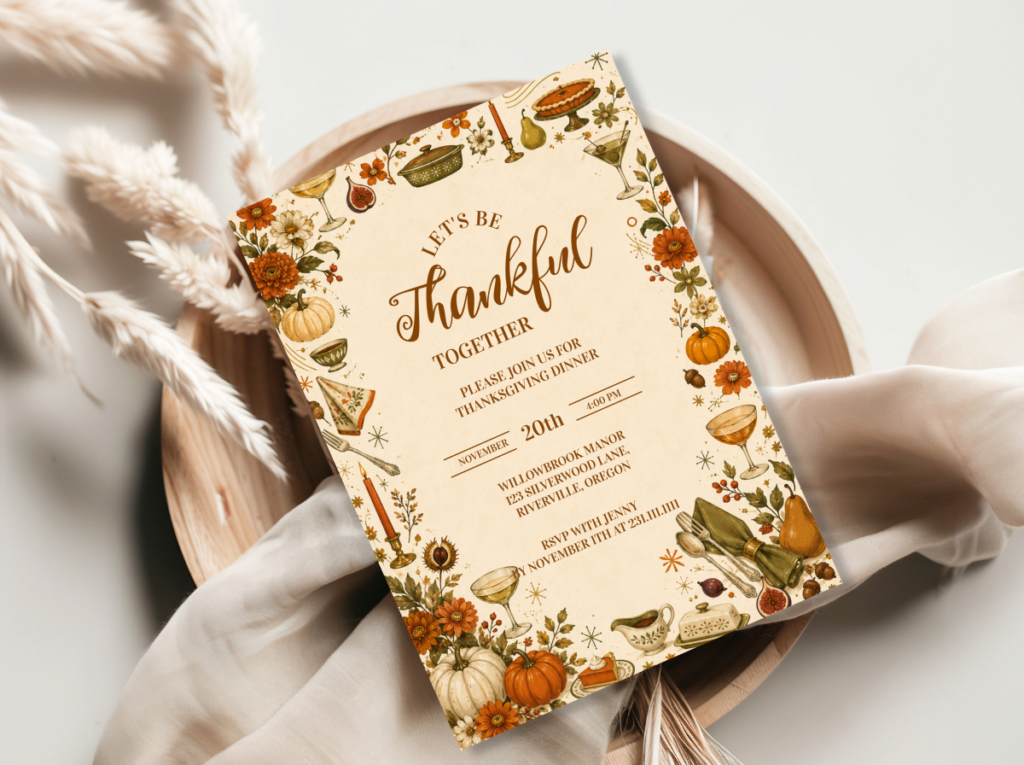
The Vintage Thanksgiving Supper Club collection at Lush Party Boutique — warm, nostalgic stationery for the heirloom-recipe Thanksgiving menu.
Section 03 Printing or Displaying the Menu at the Table
A printed menu card at each place setting or a single handwritten or printed menu displayed on a stand at the table’s centre does three things simultaneously: it tells guests the structure of the meal before it begins, which allows them to pace their appetite appropriately; it removes the need for the host to narrate each course as it arrives; and it functions as a design element of the table setting in its own right.
The per-seat menu card. A small printed card — the same size as a place card or slightly larger — placed at each setting with the evening’s menu listed in course order is the most formal and the most personal of the menu presentation options. It is addressed implicitly to the guest at that seat, and it is picked up and read before the first course arrives — which makes it the first piece of information the guest receives about the meal. The menu card should be in the same typeface and palette as the invitation and place card suite, so that the printed elements of the table read as a single designed whole. At Lush Party Boutique, the Adult Thanksgiving Party and Vintage Supper Club stationery suites include designs appropriate for this purpose.
The single displayed menu. A single menu card propped on a small stand at the table’s centre, or written on a small chalkboard or paper sign positioned where all guests can read it, performs the same information function as a per-seat card with significantly less production effort. For a gathering of ten or more, a single displayed menu is the practical choice; for a smaller, more formally set table, per-seat cards produce the more personal result. The displayed menu should be legible from across the table — which means the typeface and the size of the lettering need to be considered before the card is prepared rather than after.
The Adult Thanksgiving Party collection at Lush Party Boutique — menu cards and printed table stationery for the complete Thanksgiving dinner experience.
Frequently Asked Questions
How many dishes does a Thanksgiving menu actually need?
For a gathering of eight to twelve adults, the most functional Thanksgiving menu is a starter, a main with three sides, and a dessert — seven components total, including the sauce. This is enough to feel abundant without producing the uniformity problem that comes from too many dishes at identical richness levels, and it is manageable within a standard kitchen’s constraints. Four sides is the practical maximum for a single-oven kitchen; beyond four, the timing becomes a logistics problem rather than a cooking one. The number of dishes matters less than their balance: three dishes with good contrast across richness, acidity, and preparation method produce a more satisfying meal than seven dishes that are all rich and all starchy.
How do I plan oven timing for multiple Thanksgiving dishes?
Start with the main course and work backward from the time it needs to come out of the oven. Map every other dish that requires oven time onto the same timeline, noting the temperature each needs and the duration. Where two dishes require conflicting temperatures simultaneously, identify which can be cooked earlier and held warm, which can be roasted at a slightly different temperature without significant quality loss, and which requires a precise temperature and therefore cannot be moved. The dishes that can be made entirely in advance — the day before or the morning of — should be identified and prepared first, reducing the on-the-day oven demand to the minimum possible. A stovetop or warming tray to hold completed dishes at temperature frees oven space for the dishes that cannot be prepared in advance.
Should I print a menu card for guests at Thanksgiving?
A printed menu card is worth adding whenever the gathering has the character of a hosted dinner rather than a family meal — which is to say, whenever the host wants the structure of the meal to be communicated as a designed sequence rather than as dishes that emerge from the kitchen as they are ready. A menu card tells guests how many courses are coming before the first one arrives, which allows them to pace their appetite appropriately rather than filling up on the early dishes and missing the later ones. It also removes the social friction of guests not knowing whether to expect more food — which can make guests hold back from second helpings of the side dishes for fear of missing a course that has not been announced. For a gathering of six or more at a dressed table, a per-seat menu card is a low-cost addition that consistently improves the guest experience.
Balance · Oven Schedule · One New Dish · Menu Card
Shop Thanksgiving Menu Cards & Table Stationery
Menu cards and dinner party stationery that present the Thanksgiving meal as the designed occasion it is.